The United States Bureau of Reclamation (“Reclamation”) has issued its final Environmental Impact Statement (“EIS”) report on the post-2026 operation of water resources and infrastructure in the Colorado River Basin. Current operating guidelines for the Basin are set to expire at the end of 2026 and without new guidelines in place, Reclamation would return to pre-2007 operating procedures which do not account for the current level of drought along the Colorado River. Although officials from the seven Colorado River Basin states – Arizona, California, Colorado, Nevada, New Mexico, Utah, and Wyoming – have spent the last several years in negotiation over how to manage the river after 2026, they have so far failed to reach an agreement. Without an agreement from the states, Reclamation has developed an approach to coordinate management of critical infrastructure along the Colorado River to manage water supplies through 2036.
Background
The Colorado River is one of the most important waterways in the Western United States. Its headwaters are located in the Rocky Mountains in Northern Colorado where it then flows south through Utah and Arizona before crossing the border between the United States and Mexico to terminate in the Gulf of California. The river is 1,450 miles long and has a basin that covers more than 246,000 square miles. In the United States, the Colorado River provides water to over 40 million people.
Management of the Colorado River is governed by a legal framework known as the Law of the River. It is made up of various compacts, state and federal laws and Supreme Court decisions that allocate water rights and manage water deliveries throughout the Colorado River Basin. The Colorado River Compact of 1922 (“the Compact”) serves as the basis for the Law of the River. Drafted by officials from the seven Basin States and ratified by Congress, the Compact divided the Basin into the Upper and Lower Basins and apportioned the Colorado River between them. The Upper Basin includes Colorado, New Mexico, Utah and Wyoming while the Lower Basin includes Arizona, California, and Nevada. Under the Compact, both the Upper and Lower Basins are entitled to 7.5 million acre-feet (“MAF”) of water each year. Additionally, the Compact grants the Lower Basin the right to use an additional 1 MAF of water each year and prohibits the Upper Basin from causing the river’s flow to dip below 75 MAF of water for any period of ten consecutive years.
While the Compact granted both the Upper and Lower Basins an annual supply of 7.5 MAF of Colorado River water, subsequent agreements divided the water further within each Basin. In the Upper Basin, Colorado is entitled to 51.7% of the Upper Basin’s annual apportionment, while New Mexico receives 11.25%, Utah receives 23% and Wyoming receives 14%. In the Lower Basin, California is entitled to 4.4 MAF of water while Arizona is entitled to 2.8 MAF and the remaining 300,000 acre-feet go to Nevada.
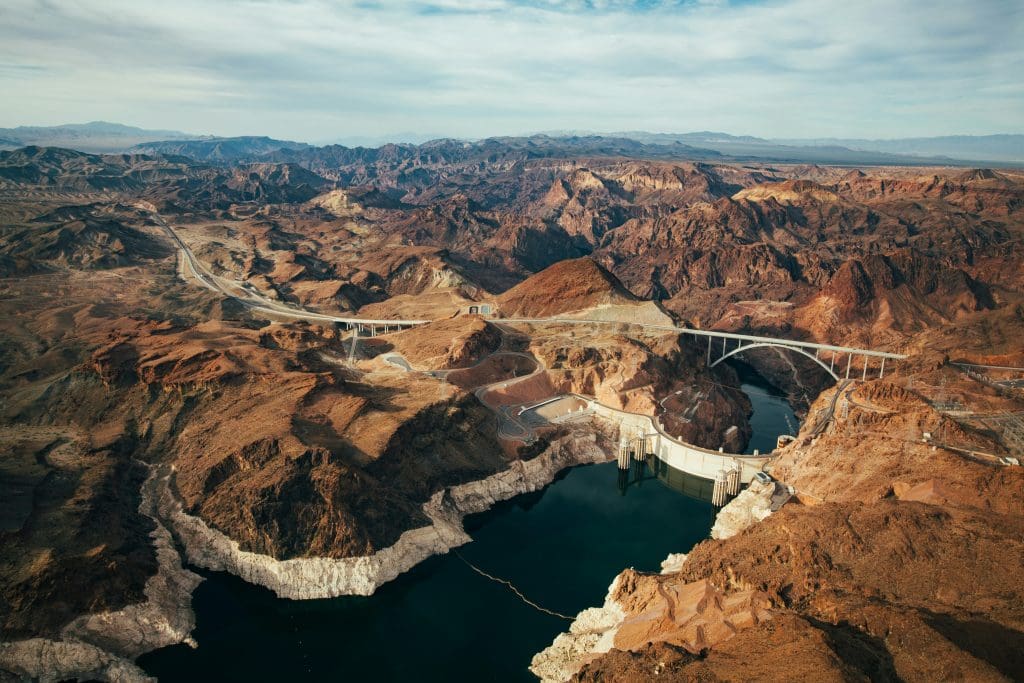
Along with the seven Basin States, Reclamation plays an essential role in managing resources on the Colorado River. Reclamation is responsible for overseeing the operation of infrastructure on the river, including Lakes Powell and Mead, the most important reservoirs in the Colorado River System. As part of its management responsibilities, Reclamation is tasked with developing and implementing operating guidelines for the reservoirs and associated dams, Glenn Canyon Dam which created Lake Powell and Hoover Dam which created Lake Mead. Reclamation manages water in the Colorado River by contracting with users throughout the Basin for annual water deliveries. Because Reclamation is a federal agency, its management decisions are subject to federal laws such as the National Environmental Policy Act (“NEPA”) which requires federal agencies to consider the environmental impacts of their actions.
While the Compact continues to govern water allocations on the Colorado River, conditions have evolved considerably since 1922. Droughts and variations in hydrology have affected reservoir levels and water demand has increased throughout the region. Since 2000, the Basin has been experiencing a historic multi-decade drought that has further strained resources. In 1922, the Colorado River averaged an annual flow of 16.5 MAF. Currently, the river produces only about 12 MAF a year.
In 2007, in response to increasing drought, Reclamation adopted the Colorado River Interim Guidelines for Lower Basin Shortages and the Coordinated Operations for Lake Powell and Lake Mead (“2007 Interim Guidelines”). Through the Guidelines, Reclamation developed a framework for managing water shortages and coordinating operations between the two main reservoirs. Water deliveries to Lower Basin States are reduced according to elevation thresholds in Lake Mead with reductions starting when the reservoir falls below 1,075 feet above sea level. Although the 2007 Interim Guidelines were intended to respond to shortages, supplemental guidelines were adopted in 2019 to respond to worsening drought. Under the 2019 supplemental guidelines, the three Lower Basin States agreed to conserve a combined total of 3 MAF of water before 2026 in exchange for compensation from the federal government.
Both the 2007 Interim Guidelines and the 2019 supplemental guidelines are set to expire by the end of 2026. Without new guidelines in place, Reclamation would return to operating Colorado River infrastructure according to pre-2007 methods which do not account for the current level of drought. Since 2020, Reclamation has been engaging with the Basin States and other interested parties on the development of post-2026 operational guidelines. However, the Basin States have so far been unable to reach agreement. In 2023, Reclamation initiated a NEPA process to begin exploring different post-2026 management options. NEPA is a federal statute that requires federal agencies to develop reports known as Environmental Impact Statements prior to taking major federal actions. EIS reports examine the environmental impacts of a proposed agency action and require the drafting agency to consider more than one alternative to its preferred action. Reclamation published a draft EIS on the post-2026 operation guidelines in January 2026. That document, which was open for a 45-day public comment period, examined five different options for managing the Colorado River. More information on those alternatives is available here. While it is typical for federal agencies to identify a preferred alternative in a draft EIS, Reclamation declined to do so in its draft EIS, noting that it wanted to give the Basin States more time come to an agreement.
With the states unable to reach consensus and the end of 2026 approaching, Reclamation has released its final EIS on post-2026 management of the Colorado River. The document, titled Post-2026 Operational Guidelines and Strategies for Lake Powell and Lake Mead, identifies Reclamation’s preferred approach for managing the Colorado River after the 2007 Interim Guidelines expire.
Final EIS
Reclamation’s final EIS on post-2026 management of the Colorado River outlines the agency’s preferred approach to managing the river after the current guidelines expire. Under that approach, Reclamation would establish a 10-year “decision framework” which would govern the river through 2036. The framework itself would not establish specific operating guidelines. Instead, the framework allows for operating guidelines to be developed and updated every two years according to a set of operational principles and certain limitations that Reclamation refers to as “sideboards.”
In the final EIS, Reclamation identifies four operational principles that will guide the development of operating guidelines under the decision framework. First, operation of the Colorado River System should be responsive to hydrology. Annual operations and any mid-year adjustments should consider changing supply conditions to support flexible management. Second, critical infrastructure such as Lakes Powell and Mead, should be protected through “practical and deliberate” operations. To that end, Reclamation has identified tools to prevent damage to infrastructure should water levels in either Powell or Mead fall below certain levels. Third, operating guidelines developed under the EIS decision framework should implement the Law of the River while also addressing extraordinary circumstances. Reclamation intends to develop operating guidelines in compliance with existing law while also taking action to protect critical infrastructure. Finally, the fourth operational principle provides that the operating guidelines should prioritize consensus-based recommendations. Reclamation noted in its final EIS that it will continue to support efforts from the Basin States to reach agreement on managing the Colorado River and that any such agreements will be prioritized as new operating guidelines are developed.
Along with identifying operational principles to inform the development of operating guidelines, the final EIS also includes operational “sideboards” which Reclamation describes as “key thresholds” that set boundaries for each set of guidelines. These sideboards set outer limits on releases from both Lakes Powell and Mead and for water cuts and storage. For example, the sideboards provide that Lake Powell could release anywhere from 5 MAF to 12 MAF of water in a given year depending on water levels in the reservoir. Additionally, the sideboards would allow up to 3.6 MAF of water to be cut from the Lower Basin’s annual water supply each year depending on hydrologic conditions. Notably, that amount is double the 1.6 MAF annual reductions that the Lower Basin states suggested in a proposed agreement released in May 2026.
Although Reclamation has not formally finalized the first round of operating guidelines, intended to cover management on the Colorado River from 2027-2028, the agency included a preliminary description of the guidelines in the final EIS. Importantly, those guidelines anticipate a total Lower Basin shortage volume of 1.5 MAF should water levels at Lake Mead fall below 1,145 feet. If that occurs, Arizona would face water reductions of 760,000 acre-feet, California would see a reduction of 440,000 acre-feet while Nevada would see a reduction of 50,000 acre-feet. The elevation of Lake Mead as of July 2026 was around 1,041 feet. The proposed reductions are likely to be particularly burdensome for Arizona’s Central Arizona Project, a 336-mile aqueduct system that delivers Colorado River water to water users throughout central and southern Arizona.
According to the final EIS, Reclamation would use the operational principles and sideboards to guide the development of operating guidelines every two years. The first set of guidelines would cover 2027-2028, while subsequent guidelines would be developed every two years until 2036. Each set of guidelines would be developed with input from stakeholders in an effort to seek consensus, account for hydrologic conditions, and any other developments in the Basin. Reclamation notes that, once finalized, operating guidelines would be formally adopted upon publication in the Federal Register.
Going Forward
Absent a consensus agreement from the Basin States, it is likely that Reclamation’s final EIS will provide the basis for managing the Colorado River System through 2036. Although Reclamation has yet to finalize operating guidelines for the 2027-2028 period, the preliminary description incorporates steep water cuts across the Lower Basin which will likely impact farmers throughout the region. Some states, Arizona in particular, have issued statements opposing Reclamation’s suggested approach. Notably, Arizona has already aside millions of dollars for a potential litigation fund to enforce the 1922 Compact and its guarantees to the Lower Basin. While Reclamation and the Basin States continue to work for a consensus agreement, it is possible that the final EIS and 2027-2028 operating guidelines for the Colorado River will ultimately end up in court.
To view the final EIS and accompanying documents, click here.
For more information on water law from the National Agricultural Law Center, click here.