
By Phillip Powell
National Agricultural Law Center
University of Arkansas Division of Agriculture
Fast Facts
- New Nebraska law paves the way for protecting farmer data
- Iowa and Missouri are considering similar laws
- Farmers, individual farms in Nebraska now own data generated by ag technologies

Will Scobey of the National Agricultural Law Center. (File photo).
FAYETTEVILLE, Ark. — Nebraska leads the way on ensuring farmers own the data produced by their operations after the state’s governor signed the Agricultural Data Privacy Act into law.
This is important because agronomic data produced by the farmer might be used by a company that developed the technology in a farmer’s equipment, such as drones and GPS-guided tractors, without the farmer’s knowledge.
“Typically, when farmers buy new technology, like a drone from a manufacturer, they may not realize they are also signing a user agreement giving the company ownership of data produced by that technology,” said Will Scobey, a staff attorney with the National Agricultural Law Center. “With the passage of the Agricultural Data Privacy Act, each farmer producing the data in Nebraska will own that data, with some notable exceptions like aggregated and public data produced on the operation.”
With Gov. Jim Pillen’s signature in April, Nebraska became the first to establish ownership rights and safeguards for a wide array of data generated by farmers, Scobey wrote in his recently published analysis.
Two other states, Iowa and Missouri, have similar active legislation. Iowa’s bill, H8407 has passed through its House of Representatives, while Missouri’s House Bill 3409 remains in committee.
Defining agricultural data
Common examples of agricultural data include soil health, crop production, climate and weather information. Under the new law, agricultural data is defined as being “linked to an identified or identifiable agricultural producer, farm, parcel, device, or equipment.”
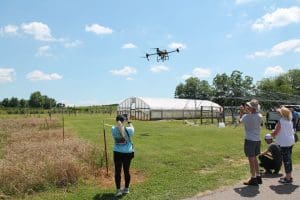
Nebraska has become the first state to enact a law giving farms and farmers ownership over the agronomic data that night be generate by drones and combines. (UADA file image)
Scobey said the law’s primary purpose is to regulate companies known as agriculture technology providers, or ATPs. Companies must have written consent to sell the data generated by their clients and comply with stricter security guidelines to protect the data.
“Nebraska has changed the game on agricultural data by ensuring each farmer will own the data they produce on their operation using technologies from agricultural technology companies,” Scobey said.
About the National Agricultural Law Center
Created by Congress in 1987, the National Agricultural Law Center serves as the nation’s leading source of agricultural and food law research and information. The NALC works with producers, agribusinesses, state and federal policymakers, lenders, Congressional staffers, attorneys, land grant universities, students, and many others to provide objective, nonpartisan agricultural and food law research and information to the nation’s agricultural community.
The NALC is a unit of the University of Arkansas System Division of Agriculture and works in close partnership with the USDA Agricultural Research Service, National Agricultural Library.
To learn more about ag and food research in Arkansas, visit aaes.uada.edu. Follow the Arkansas Agricultural Experiment Station on LinkedIn and sign up for our monthly newsletter, the Arkansas Agricultural Research Report. To learn more about the Division of Agriculture, visit uada.edu. To learn about extension programs in Arkansas, contact your local Cooperative Extension Service agent or visit uaex.uada.edu.
About the Division of Agriculture
The University of Arkansas Division of Agriculture’s mission is to strengthen agriculture, communities, and families by connecting trusted research to the adoption of best practices. Through the Agricultural Experiment Station and the Cooperative Extension Service, the Division of Agriculture conducts research and extension work within the nation’s historic land grant education system.
The Division of Agriculture is one of 22 entities within the University of Arkansas System. It has offices in all 75 counties in Arkansas and faculty on three system campuses.
Pursuant to 7 CFR § 15.3, the University of Arkansas Division of Agriculture offers all its Extension and Research programs and services (including employment) without regard to race, color, sex, national origin, religion, age, disability, marital or veteran status, genetic information, sexual preference, pregnancy or any other legally protected status, and is an equal opportunity institution.
# # #
Media Contact:
Phillip Powell
National Agricultural Law Center
ppowell1@uark.edu