By Mary Hightower
University of Arkansas Division of Agriculture
See “conventional” version of story
MEMPHIS, Tenn. — Farm Bill feuding, land sale fraud, and whether the country needs to consider a different path for farm safety nets were among the insights offered at the 13th annual Mid-South Agricultural and Environmental Law Conference.
Held June 4-5 at the University of Memphis’ Cecil C. Humphreys School of Law, the conference featured the “Next Generation of Ag & Food Law: Roundtable for Students” and a full day of professional development and insights on ag labor, finance, artificial intelligence and ongoing legal battles over water and pesticides.
Here’s what was covered:
- Farm Bill
- Deregulation
- Trade deficit
- Screwworm
- How do I defraud thee?
- Ag Labor
- Illinois River
- Failure to Warn
Farm Bill
Hunt Shipman, principal and director of Cornerstone Government Affairs was asked if there would ever be a Farm Bill.
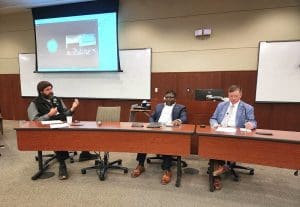
Harrison Pittman, left, moderates the panel discussion: “Update from the Potomac: Farm Bill, Ag Trade, MAHA, & More.” Center, Dr. Andrew Muhammad, Professor, University of Tennessee Institute of Agriculture, Department of Agricultural and Resource Economics; at right, Hunt Shipman, Principal and Director, Cornerstone Government Affairs. Taken June 5, 2026, at the t the Mid-South Ag and Environmental Law Conference. (NALC photo)
“We have broken, what we call in our office the three-legged stool of conservation, commodities and nutrition. Putting them back together is like trying to get the Hatfields and McCoys to have dinner together,” he said.
Playing in the background, “there is narrative [that asks] that whether the farm safety net is broken because of all these ad hoc programs,” Shipman said. “We may have created a bigger long-term problem for farmers.
“Do we need a different model for programs than what we have today? I don’t think we have time in this Congress” to fix it for this Farm Bill, he said.
He said it might be a topic to work on before the next Farm Bill.
As for gridlock in Washington, Shipman offered some optimism.
“We saw glimmers of that this week with the Senate stopping the weaponization fund,” he said. “You’ve seen it with stopping the FISA bill last night.”
With the House moving 10 appropriations bills through floor committees and the Senate moving bills individual through committee this year, Shipman said. “This is closer to order than we’ve seen in a decade.”
However, “mid-term election year could be the thing that throws it into chaos,” he said.
Deregulation
Dudley Hoskins, U.S. Department of Agriculture undersecretary for marketing and regulatory programs, offered insights into the work being done by the Animal and Plant Health Inspection Service and the Agricultural Marketing Service. It’s a wide range that includes training the “beagle brigade” that sniffs out prohibited items at airports, to ensuring new diseases don’t affect the food supply and working to halt the ones that do.
In 2024, the U.S. Supreme Court ruled in the case of Loper Bright Enterprises Inc. v. Raimondo, a case that focused on what was known as the Chevron doctrine. Under that 1984 rule, federal courts defer to federal agencies’ expertise when a statute is ambiguous. The 2024 ruling scuttled that doctrine.
“As we look at a post-Loper world, there’s additional pressure and tension as we look at a deregulatory agenda,” Hoskins said, centering on “how we articulate what our authorities are.”
“It has been a very time-consuming and involving process and we rely heavily on our partners at the office of the general counsel,” he said. “As we work through our dereg agenda, we ask that people and industry partners please weigh in on those in the public commenting process. It’s important as we recalibrate and that they work for our producer partners and are legally viable and defensible.”
“This is another place where the National Ag Law Center plays a critical role for our commodity and industry groups that want to weigh in on different regulatory priorities,” Hoskins said.
To read the full news release, click here.