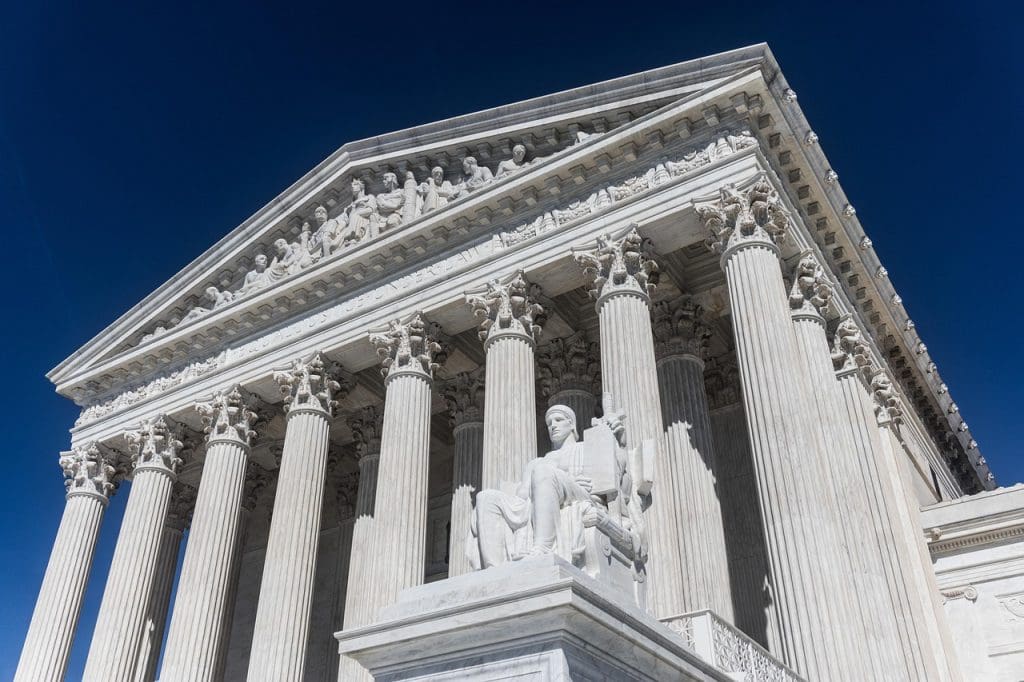
On November 10, 2026, the Supreme Court heard oral argument in Dep’t of Labor v. Sun Valley Orchards, LLC, No. 25-966 (2026). The case involves a dispute between the Department of Labor (“DOL”) and a New Jersey farm over DOL’s constitutional authority to issue monetary penalties against agricultural employers who violate the H-2A temporary foreign labor program. Currently, if an employer is found to be in violation of certain H-2A program requirements, the DOL can order the employer to pay financial penalties as a result. However, Sun Valley Orchards argues that under the United States Constitution, only a federal court can impose such penalties. Should the Supreme Court agree with Sun Valley Orchards, the decision would likely result in DOL no longer having the authority to use agency adjudication to impose civil penalties on employers who violate at least some aspects of the H-2A program. Instead, such cases may need to go to court before penalties could be imposed.
While this case focuses on DOL and its administration of the H-2A program, the decision could ultimately have broader consequences for other federal agencies that rely on internal adjudicators to issue penalties for violating certain statutes or programs.
Background
The dispute in Dep’t of Labor v. Sun Valley Orchards arises out of H-2A violations that Sun Valley Orchards allegedly committed in 2015. Although the question currently before the Supreme Court focuses on when a federal agency can rely on internal agency adjudicators, known as administrative law judges (“ALJ”), to impose civil penalties, it is helpful to first understand the H-2A program and how this case reached the Supreme Court.
H-2A Basics
The H-2A program was created by Congress in 1986 for the purpose of providing agricultural employers with an alternative source of labor when domestic workers are unavailable. Through H-2A, agricultural employers who are unable to find enough domestic workers to fulfill the labor needs of their operations may hire non-immigrant foreign workers as seasonal or temporary employees. The program is administered by DOL which grants employers the ability to bring H-2A workers into the country.
Employers looking to participate in the H-2A program must meet several requirements. First, the employer must obtain a certification from DOL that there are not enough domestic workers who are “able, willing, and qualified” to perform the work the employer needs done, and that employment of foreign workers will not adversely affect the wages and working conditions of domestic workers in the United States. 8 U.S.C. § 1188(a)(1). As part of that certification process, the employer must “agree” to “abide by the requirements” of the H-2A program. 20 C.F.R. § 655.135. The employer must also submit a “job order” to DOL that outlines the terms and conditions of employment, such as the duration of the work period or any deductions made from wages, which the agency reviews to determine whether those terms and conditions comply with the H-2A program. 20 C.F.R. §§ 655.103; 655.121. Should the job order be approved, it serves as the “minimum” work contract between the H-2A employer and H-2A employees. 20 C.F.R. § 655.122(q). Once the employer receives certification from DOL, the employer must then file a petition to “import” a foreign national as an H-2A worker with the Department of Homeland Security. 8 U.S.C. § 1184(c). If the petition is approved, the foreign worker must obtain a visa at either a U.S. embassy or consulate before traveling to the United States. 8 U.S.C. § 1201.
In order to retain the ability to bring foreign H-2A workers to the United States, employers must comply with any “criteria for certification” including those prescribed by DOL. 8 U.S.C. § 1188(c)(3)(A). Similarly, employers must provide H-2A workers with “housing in accordance with regulations.” 8 U.S.C. § 1188(c)(4). Through implementing regulations, DOL has adopted various “criteria for certification” and housing requirements that employers must comply with in order to avoid violating the H-2A program. For example, employers must provide foreign workers with suitable housing, access to a kitchen or meal plan, safe transportation to and from a worksite, and guaranteed employment for at least three-quarters of the workdays for which the foreign worker has been hired. 20 C.F.R. § 655.122.
Along with the authority to grant employers the ability to bring foreign workers into the country, Congress also granted DOL the authority to “take such actions, including imposing appropriate penalties” necessary to ensure employers remain compliant with the requirements of H-2A. 8 U.S.C. § 1188(g)(2). Under that authority, DOL has adopted regulations establishing an internal administrative process to enforce program obligations, including recovering monetary civil penalties. 29 C.F.R. § 501.16. According to those regulations, if DOL determines that an employer has violated the statutory requirements of H-2A or its implementing regulations, it will issue a written notice informing the employer of DOL’s findings and the penalty the Department intends to impose. 20 C.F.R. §§ 501.31, 501.32. The employer may then demand a hearing before an ALJ. 29 C.F.R. § 501.33. An ALJ is a type of judge who operates independently within an agency and is authorized to conduct hearings, review evidence, and issue decisions on disputes involving government regulations and benefits. When an agency requires a matter to be adjudicated by an ALJ, federal law requires that the parties complete the agency adjudication process and receive a final order from the ALJ before the issue can be brought to a court of law. 5 U.S.C. § 704.
After the ALJ issues a final decision on whether an employer violated H-2A requirements, any party to the proceeding may appeal the ALJ’s decision to the Administrative Review Board, a multi-member board of adjudicators within DOL. 29 C.F.R. § 501.42. After the Review Board issues its final decision, the parties may then seek judicial review of the final order.
Pathway to the Supreme Court
The dispute at the heart of Dep’t of Labor v. Sun Valley Orchards arose from the 2015 growing season when the defendant, a fruit and vegetable farm located in New Jersey, was granted permission through the H-2A program to bring 96 foreign workers into the United States. Through a job order, the defendant promised employees the following: at least 40 hours of work per week for 26 weeks of employment; guaranteed employment for the hourly equivalent of three quarters of the hours promised in the agreement in compliance with H-2A requirements; no-cost housing and free transportation to the worksite; and free cooking and kitchen facilities for workers to prepare their own meals.
According to DOL, the defendant failed to fulfill the terms and conditions outlined in the job order. Following an investigation, DOL determined that the housing provided by the defendant did not satisfy federal standards due to missing window screens and a lack of hot water. DOL also found that the defendant had failed to provide workers with kitchen facilities and instead charged workers for a weekly meal plan without first providing notice. Finally, DOL concluded that the defendant had violated the “three-fourths guarantee” by terminating the employment of several workers before they had completed the guaranteed number of work hours. As a result of that finding, DOL ordered the defendant to pay $212,250 in civil penalties and $369,703 in back wages.
The defendant requested a hearing before an ALJ. There, the ALJ affirmed the DOL’s initial findings but modified the penalties, lowering the amounts to $211,800 in civil penalties and $344,945 in back wages. The defendant then petitioned the Administrative Review Board for review of the ALJ’s decision, which the Review Board ultimately upheld. After exhausting the DOL’s internal adjudication process, the defendant challenged DOL’s decision in federal court.
In court, the defendant argued that DOL lacked the constitutional authority to adjudicate private rights and impose civil penalties. Specifically, the defendant claimed that DOL’s internal adjudication process violated Article III of the United States Constitution which provides that “judicial power […] shall be vested in one supreme court, and in such inferior courts as the Congress may from time to time ordain and establish.” U.S. Const. Art. III, § 1. The district court disagreed with the defendants and concluded that DOL had not violated the Constitution. However, on appeal the Third Circuit concluded that DOL had violated the Constitution and that the matter should have been heard in a federal court rather than an agency adjudication. DOL appealed that decision to the Supreme Court.
Arguments Before the Supreme Court
At the Supreme Court, DOL and the defendant, Sun Valley Orchard, have asked the justices to determine whether the Constitution prohibits DOL from adjudicating proceedings to collect monetary penalties from employers who have allegedly violated the terms and conditions of employment of H-2A workers. The case focuses not on whether Sun Valley Orchard violated H-2A, but rather on the overall constitutionality of DOL’s adjudication process.
DOL’s Argument
DOL argues that the adjudication process is constitutional because Article III of the Constitution allows Congress to assign adjudications involving “public rights” to executive agencies rather than federal courts and the Supreme Court has a history of recognizing immigration benefits as public rights.
Article III of the Constitution clarifies that judicial power is vested the Supreme Courts and other federal courts established by Congress. While Article III grants Congress the authority to establish lower courts vested with judicial power, like it did when it established the federal circuit courts, Congress may not grant the federal government’s judicial power to entities not included in Article III. While the exercise of judicial power includes conducting adjudications – meaning, the process of determining facts, applying a rule of law to those facts, and arriving at a decision – not every adjudication involves the exercise of judicial power. Executive officers also have the ability to conduct adjudications. For example, the Patent Board, established by the first Congress through the passage of the Patent Act of 1790, was an executive agency that adjudicated disputes surrounding the patentability of inventions. While agency adjudications may appear similar to judicial proceedings, they are considered exercises of the executive power.
The determination of whether a dispute may be resolved through the exercise of judicial power or executive power hinges on the distinction between “private rights” and “public rights.” Private rights are considered the core of the historically recognized judicial power, and thus disputes involving private rights should be resolved within a court of law. However, it remains up to Congress to decide whether adjudications involving public rights should be assigned to courts or to executive agencies. While there is no clear-cut rule indicating the distinction between public and private rights, in general the Supreme Court has found that public rights include privileges or benefits granted by the government. For example, disputes over payments to veterans are considered to involve public rights because they concern benefits granted by the government.
DOL argues that its internal adjudication process is a constitutional exercise of its executive power because immigration has primarily been seen as a matter of public rights. To establish that claim, DOL noted that the earliest immigration laws passed by Congress – the Alien Friends Act and the Alien Enemies Act of 1798 – empowered the Executive Branch to adjudicate disputes over whether foreign nationals could be expelled from the United States. DOL argues that because immigration laws have established that foreign nationals have no private right to enter or remain in the United States, that domestic employers thus have no private right to bring foreign nationals into the United States. Instead, the ability to bring foreign nationals to the United States is a benefit that the government may grant to employers, and that Congress may require those employers to satisfy terms and conditions in order to retain that benefit.
DOL argues that the H-2A program does exactly that. According to DOL, when Congress established the H-2A program, it authorized the agency to grant domestic employers the ability to bring foreign nationals into the United States provided the employer remains compliant with certain requirements. Congress also authorized DOL to exercise its executive authority to adjudicate whether an employer remains compliant with those requirements and to issue penalties when the agency determines that the employer has fallen out of compliance. Because the ability to bring foreign nationals into the United States is a benefit that the government grants employers, DOL claims that the benefit is a public right and disputes concerning those rights may therefore be heard in agency adjudication.
Sun Valley Orchard’s Argument
Sun Vally Orchard argues that the question of whether it violated the H-2A program and should face monetary civil penalties involves private rights that the Constitution requires be heard in a federal court of law. To support that argument, Sun Valley relied on a recent Supreme Court case which held that if a dispute resembles an “action at common law,” then the matter presumptively concerns private rights and should be heard in a federal court.
In 2024, the Supreme Court issued SEC v. Jarkesy, 603 U.S. 109 (2024) where the Court concluded that in cases where a federal agency seeks to impose civil penalties for a legal violation that resembles common law fraud, the defendant is constitutionally entitled to a jury trial. In that case, the Court was asked to consider whether the Securities and Exchange Commission (“SEC”) had violated the defendant’s Seventh Amendment right to a jury trial by imposing civil penalties for violations of antifraud provisions of federal securities laws through an agency adjudication. The Seventh Amendment guarantees a right to trial by jury for “suits at common law,” which the Supreme Court has held extend to claims that are “legal in nature.” Typically, courts consider a matter to be legal in nature if the remedy being sought includes monetary damages designed to punish the wrongdoer.
In SEC v. Jarkesy, the Supreme Court determined that because the SEC’s use of civil penalties was intended to punish an individual, the matter was legal in nature and therefore the defendant was entitled to a jury trial. Although the SEC argued that the dispute involved public rights, the Court disagreed, concluding that the antifraud provisions of the securities laws at issue in the case were similar to common law fraud and that cases involving common law must be heard in federal courts. For an in-depth review of SEC v. Jarkesy, click here.
Relying on the Court’s ruling in SEC v. Jarkesy, Sun Valley argues that the question of whether it violated the H-2A program and should be assessed penalties should have been heard in a federal court because the claims against it resemble common law breach-of-contract claims. Sun Valley argues that the job order it relied on to hire H-2A workers for the 2015 growing season functions as a work contract between itself and the workers. Because DOL imposed penalties against Sun Valley as a result of the operation allegedly failing to fulfill the terms of the job order, Sun Valley argues that DOL essentially pursued a breach-of-contract claim against it. Because breach-of-contract claims are generally regarded as disputes of common law, Sun Valley argues that the case against it involves private rights and therefore should have been resolved through a federal court instead of an agency adjudication.
Potential Impacts
At the time of writing, it is not clear how the Supreme Court will ultimately rule on this issue. Should the Court rule in favor of DOL, the adjudication process would likely remain in place. However, should the Court rule in favor of Sun Valley, it is unlikely that DOL would continue imposing penalties for H-2A program violations through the agency adjudication process. Instead, DOL may need to rely on the federal courts to impose such penalties. Either outcome is likely to have broad implications. Should Sun Valley prevail, the decision could cast doubt on whether agencies besides DOL can rely on agency adjudications to impose civil penalties. A ruling for Sun Valley may also result in some initial uncertainty over how DOL will enforce the H-2A program going forward.
The Court’s decision is not expected until 2027. The National Agricultural Law Center will provide further updates once that decision is released.
To read DOL’s brief in Dep’t of Labor v. Sun Valley Orchards, click here.
To read Sun Valley Orchard’s brief in Dep’t of Labor v. Sun Valley Orchards, click here.
To read the Third Circuit’s decision, click here.
To read the Supreme Court’s decision in SEC v. Jarkesy, click here.
For more NALC resources on administrative law, click here.