On August 10, 2026, Department of Health and Human Services (HHS) Secretary Robert Kennedy made two major announcements related to the agency’s “Make America Health Again” priorities. First, the Secretary proposed rulemaking to reform the “Generally Recognized as Safe” or “GRAS” pathway, and second, he announced that a white paper detailing the joint FDA and USDA proposed definition for ultra-processed foods (UPFs) was sent to the White House. It is not clear at this time when the UPF definition will be published, nor what it will contain. However, the GRAS reforms have been officially proposed and are now in a public comment period. In light of the proposal, this article will discuss the history of GRAS along with the changes this rule would make. To read the proposed rule in its entirety or make a public comment, click here.
What is GRAS?
In the most general of terms, GRAS is a pathway for food manufacturers to introduce new food ingredients or new uses for ingredients into the marketplace. Specifically, this pathway allows food substances that are purported to be “generally recognized as safe under the conditions of [their] intended use” into the marketplace without having to undergo FDA’s food additive approval process. Under the Food, Drug, and Cosmetic Act (FDCA), a “food additive” is “any substance the intended use of which results or may reasonably be expected to result, directly or indirectly, in its becoming a component or otherwise affecting the characteristics of any food.” 21 USC § 321(s). However, in its definition the FDCA also carves out exceptions. Specifically, a substance is not a food additive if it is “generally recognized, among experts qualified by scientific training and experience to evaluate its safety, as having been adequately shown through scientific procedures [. . .] to be safe under the conditions of its intended use.” 21 USC § 321(s). This is the GRAS exception. In other words, a GRAS substance is one that is recognized by qualified experts through scientific procedures to be safe for certain uses and at certain levels in food. Originally, this exception was created for common ingredients like flour or vinegar that were widely recognized as safe and were thus exempted by the FDCA from undergoing the food additive approval process. Over the years, GRAS has evolved and it is now used as one of the primary mechanisms by which food ingredients are introduced into the food supply. In other words, legally speaking the main difference between a food additive and a GRAS substance is not the contents of the substance nor its effect in a food, but the mechanism by which it is introduced into marketplace.
It is also important to note that GRAS hinges on the “conditions of its intended use.” This means that when GRAS conclusions are being drawn, the determination revolves around whether the substance is “generally recognized as safe” for that use and at that level in the food. Because its determination hinges on intended use, a particular substance could be both GRAS for one use but a food additive for another. For instance, a substance could be approved by the FDA as a food additive for the purpose of preserving food but could also be used as a GRAS substance for flavor enhancement.
To make it even more complicated, both food additives and GRAS are distinguished from “color additives,” which are substances used in food specifically for the purpose of coloring it. Color additives have a mandatory approval process that is separate from food additives; however, a color additive could be considered GRAS if it is used for a purpose other than coloring the food. This is relevant because a color additive included in a food for coloring purposes would have to have its safety at intended levels tested and approved by FDA, but if added to food for another purpose, it could be GRAS and would be excluded from undergoing any FDA safety testing. To learn more about the FDA’s categories of food ingredients, click here to read NALC article “Food Foundations: Categories of Food Ingredients.”
Statutory & Regulatory History of GRAS
GRAS was first established in 1958 when Congress enacted the Food Additives Amendment to the FDCA. This amendment both defined the term “food additive” and created exemptions from what qualified as a food additive, such as GRAS substances. In addition to defining the term, the Food Additives Amendment also created a premarket review and approval process for substances that meet the qualifications of a food additive. Thus, as mentioned previously, substances that met the exemptions were not required to go through that approval process.
Since 1958, there have been a number of regulatory approaches that FDA has taken related to GRAS. The current system in place was first proposed by the agency in 1997 and finalized in 2016. It offers two pathways for food manufacturers seeking to introduce a new condition of intended use for a GRAS substance: self-affirmation or FDA notification. Self-affirmation allows a manufacturer to internally determine if their substance is GRAS without FDA’s involvement. Through self-affirmation, a manufacturer is not required to notify the agency of their determination that the substance is “generally recognized as safe” under the conditions of its intended use. This pathway is the one often referred to by opponents of GRAS as a “loophole” because it allows manufacturers to introduce substances into food without FDA’s specific approval or knowledge.
Self-affirmation pathway:

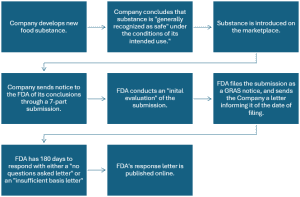
On the other hand, the second pathway for a GRAS substance is one where the FDA is more directly involved. Codified in 21 CFR § 170.205, FDA permits any person to “notify FDA of a view that a substance is not subject to the premarket approval requirements of [food additives] based on that person’s conclusion that the substance is GRAS under the conditions of its intended use.” 21 CFR Sections 170. 210 – 170.255 clarify the steps that a “notifier” will need to take. If it is filed as a GRAS notice, it will undergo another evaluation to determine if the substance is actually GRAS under the conditions of its intended use. Within 180 days of filing, FDA will send a letter to the notifier with the results of their evaluation.
FDA Notification pathway:
2026 Proposed Reforms
The 2026 proposed GRAS reforms would require FDA notification for all GRAS conclusions Specifically, these provisions would “create a framework whereby firms would still be able to render their own GRAS conclusions, but they would be required to submit these GRAS conclusions to FDA.” The proposed rule reforms the GRAS framework for both human and animal food as noted in 21 CFR parts 170 and 570, respectively.
Creation of a Mandatory GRAS Notice Requirement
The proposed rule amends 21 CFR part 170, subpart E to transition the current voluntary notice framework into a mandatory process. It first revises the definition section by adding two terms – “inventory” and “no questions letter.” Inventory refers to the public database where FDA will publish information related to GRAS notices. A no questions letter is the letter that FDA will send to the submitter of a GRAS notice which states that the agency has “no questions at this time regarding your conclusion that the notified substance is GRAS under the conditions of its intended use.” Notably, the rule clarifies that the no questions letter does not affirm that the substance is GRAS, nor does it declare the substance is an exemption from the term “food additive.” The proposed definition section also modifies the definitions of GRAS and GRAS notice to reflect the substantive changes of the rule.
Next, the proposed reform turns to § 170.205 to codify the new rules requiring mandatory GRAS notices. Here, it states that “any person introducing a substance into interstate commerce under GRAS . . . must notify FDA of the basis for their conclusion that the substance is GRAS under the conditions of its intended use.” Further, this section highlights exceptions for when a GRAS notice is not required:
- When a “no questions letter” already covers the substance under the conditions of its intended use;
- The substance is already considered GRAS under the conditions of its intended use under 21 CFR parts 182, 184, or 186;
- A substance that is considered GRAS because it is of natural biological origin and has been widely consumed in the U.S. prior to January 1, 1958 without known detrimental effects, or meets the qualifications proposed under 170.30(i)(1) for substances affirmed as GRAS “with no limitation other than good manufacturing practice;”
- The intended use of the substance has been considered by FDA through another established FDA process to evaluate the potential presence of unapproved food additives and documentation is made publicly available by FDA;
- The intended use of the substance is an exemption under the Threshold of Regulation process in Section 170.39;
- There is an effective premarket notification for a food-contact substance which covered the substance under conditions of its intended use, and the substance in interstate commerce originates from the manufacturer or supplier listed in the effective FCN; or
- Information about the conditions of use of the substance has already been submitted in accordance with the streamlined process for substances already in the market. (proposed Section 170.305, explained below)
In general, the proposed mandatory rule adopts the current framework for a voluntary GRAS notice. However, it does include a few additions and modifications. For example, under the proposed rules, a GRAS notice must be submitted electronically through the Centralized Online Submission Module unless a waiver to submit it on paper is approved. The proposed rule also requires that GRAS notices submitted in a foreign language must be accompanied by an English version.
Additionally, the proposed rule establishes a timeframe for FDA’s initial evaluation of a GRAS notice submission. Previously, for a voluntary GRAS notice, there was not a time parameter in which the evaluation had to be completed. Under the proposed rule, an initial evaluation must be done in 45 days. The following example outlines the steps a GRAS notice submission will take under the proposed rule:
- Company wants to introduce a new substance that it internally concluded is GRAS under the conditions of its intended use.
- Under the proposed rule, the company must submit a notice, consistent with the 7-part requirements, to the FDA.
- FDA will have 45 days for an initial evaluation. During this timeframe, the agency will determine whether the submission should be filed as a GRAS notice for further evaluation of the company’s safety conclusions.
- After the initial evaluation, if the GRAS notice is filed for further evaluation, the mandatory notice requirement will be met.
- FDA will then have 180 days (with the option to extend) to make a further determination on the notice’s conclusions of safety.
- After making its determinations, the agency may send a “no questions letter” or it might send a letter “stating that the notice does not provide sufficient information in support of a GRAS conclusion.” The second response would not mean that the company failed to meet the mandatory notification requirements, but it might be “relevant to [FDA’s] determination of whether a food substance is an unapproved food additive” in a post-market action.
- At any point during its evaluation of the GRAS notice, the company might ask FDA to cease its evaluation of the GRAS notice. If FDA does, it will NOT consider the mandatory notification requirement to be met.
Streamlined Process for GRAS Substances already in the Market
A new sub-section is introduced into the regulations that creates a framework for GRAS substances that are already available in the marketplace. This section creates an alternative mechanism for those manufacturers to submit their GRAS conclusions instead of requiring compliance with the process outlined in Sections 170.205-265. This streamlined mechanism will require a submission of the following information: the name and address of the submitter; an appropriately descriptive name of the substance; its intended conditions of use (such as which food it will be in, its level of use, and its purpose in food); evidence of its presence in interstate commerce before the final rule’s effective date; and if FDA sent a cease to evaluate letter in response to a submitter’s previous GRAS notice. This submission may include the statutory basis for the conclusion of GRAS status and must be submitted to FDA electronically within a year of the final rule’s effective date.
The information required in the submission will then be publicly available in the inventory. Other than clarifying about publication in the inventory, the proposed rule does not further specify what the FDA will do with this information. The proposed rule clarifies that FDA ask further questions, and that it may determine that an official GRAS notice or a food additive petition is appropriate for the intended use of the substance. This determination will also be made publicly available.
The proposed rule also includes circumstances where a submission is not permitted for a pre-final rule GRAS substance. For example, a manufacturer who has previously notified FDA of GRAS substance usage, but FDA responded with a “insufficient basis letter” telling the manufacturer that its conclusions were not enough to prove GRAS under the conditions of its intended use.
Animal Food
In addition, the rule also proposes a mandatory notification framework for animal food. Located in 21 CFR § 570, the proposed reforms for animal food mirror what is proposed for human food. The only difference is that the mandatory notification framework for animal food includes an exemption for “Official Common or Usual Names and Definitions of Feed Ingredients” published in the “Official Publication” of the Association of American Feed Control Officials (AAFCO). The proposed rule clarifies that because most of the substances listed in that section of AAFCO’s Official Publication have been previously reviewed for safety for their intended uses under the former AAFCO ingredient definition request process, they are excluded from a mandatory Thus, these substances are distinguished from other pre-final rule GRAS substances on already on the market, and will not have to submit information through the streamlined mechanism.
Effect of the Rule and Next Steps
The proposed reforms to the GRAS pathway, if finalized, will require that food manufacturers who choose to introduce new food substances or new uses for food substances into the marketplace must submit a mandatory notice to the FDA. It is important to note though that the proposed rule does not require premarket approval for GRAS substances – only notification of GRAS conclusions. This means that while a food manufacturer is required to submit its GRAS conclusions to the FDA, the manufacturer does not have to wait for the agency’s approval before introducing the substance into the marketplace. While premarket approval is not being proposed, the rule would introduce additional evaluation duties for the agency.
The rule is in a public comment period until December 9, 2026, and comments can be made here.
For more information about GRAS generally, click here for Congressional Research Service Report “Food Additives and GRAS Substances: A Legal Framework.”
For more information on the history of GRAS, click here to read “FDA’s Approach to the GRAS Provision: A History of Processes.”