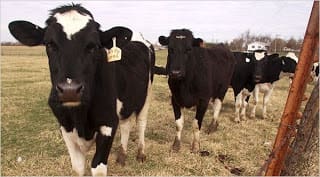
by NALC Research Fellow Jordan Berry and Senior Staff Attorney Elizabeth Rumley
In December 2003, the United States confirmed its first case of bovine spongiform encephalopathy, commonly known as mad cow disease. As trading partners restricted imports of U.S. beef, the value of U.S. beef exports fell from $3.2 billion in 2003 to $551 million in 2004 Even after the initial trade disruption, cattle exports were significantly affected for several years after the event, leading to negative impacts throughout the supply chain. This “cow that stole Christmas” illustrates how the detection of an animal disease can quickly disrupt livestock markets and underscores the rationale for tracing potentially affected animals. [1]
Consequently, USDA’s Animal Disease Traceability (ADT) program supports disease-response efforts by establishing identification and recordkeeping requirements for certain livestock moving interstate. However, USDA’s 2024 amendments requiring electronically readable ear tags for certain cattle and bison have prompted industry debate and an ongoing legal challenge.
ADT Requirements
Through the ADT program, covered livestock generally must be officially identified before moving interstate. Depending on the species and circumstances of the movement, identification may apply to an individual animal or to a group or lot. When a disease is detected, animal health officials can use that identification, together with movement records, to determine where affected animals have traveled and identify other livestock that may have been exposed. The program covers cattle and bison, horses and other equines, poultry, sheep and goats, swine, and captive cervids such as deer and elk.
The specific identification and documentation requirements vary by species. Horses and other equines moving interstate generally must be individually identified and accompanied by a certificate of veterinary inspection, although destination states may impose additional requirements. Swine generally must be identified individually, but certain shipments may use group identification, and some movements within approved production systems are exempt from individual identification requirements. Sheep and goats are subject to identification and recordkeeping requirements under USDA’s scrapie eradication program. Poultry may be identified individually or by group or lot, while captive cervids are subject to separate requirements intended to support the tracing of diseases such as tuberculosis and chronic wasting disease. The requirements for cattle and bison, however, have generated the most controversy.
These requirements trace back to 2013, when USDA first implemented the ADT regulations. The rule required certain livestock, including specified cattle that were moving interstate to bear official identification and accompanied by a certificate of veterinary inspection or other approved movement documentation. Under the original rule, producers could comply using several forms of official identification, including visual-only official ear tags in many circumstances. At the time, electronic identification was available but generally not required, which allowed producers to choose among approved identification methods.
More than a decade later, USDA issued the 2024 final rule substantially amending the official identification requirements for covered cattle and bison. Covered animals include sexually intact cattle and bison 18 months of age and older, dairy cattle, and cattle and bison used for rodeo, exhibition, or recreational purposes. The change has prompted both industry debate and ongoing litigation challenges. The principal change was the elimination of visual-only official ear tags for covered cattle and bison moving interstate. Instead, USDA requires newly applied official ear tags for covered animals to be both visually and electronically readable.
USDA explained that visual-only identification could delay livestock disease investigations, whereas electronically readable tags could improve the speed and accuracy of disease tracebacks. According to the agency, the change allows animal health officials to identify exposed animals more quickly while reducing the scope and duration of disease investigations. The amendments do not expand the categories of cattle and bison subject to the ADT regulations. [2] In addition, visual-only official ear tags applied before the rule’s effective date generally remain valid for the animal’s lifetime.
The 2024 rule has drawn differing reactions within the cattle industry. The National Cattlemen’s Beef Association (NCBA) and many state animal health officials supported USDA’s transition to electronic identification, arguing that RFID technology would improve the speed and accuracy of disease tracebacks while helping limit the economic consequences of disease outbreaks.
Other producer organizations, such as R-CALF USA, the South Dakota Stockgrowers Association, and the Farm and Ranch Freedom Alliance oppose the rule, arguing that mandatory electronic identification imposes unnecessary costs on producers, increases federal oversight, and exceeds USDA’s statutory authority. The three opposing organizations later joined individual cattle producers in filing a lawsuit challenging the rule.
2024 Challenge
The 2024 amendments have been challenged in R-CALF USA et al. v. U.S. Department of Agriculture, a case that is pending in the U.S. District Court for the District of South Dakota. The plaintiffs argue that USDA exceeded its statutory authority by requiring producers to use electronic identification. Specifically, they contend that although Congress authorized USDA to establish animal disease traceability requirements, it did not authorize the agency to mandate a particular identification technology—in this case, electronically readable ear tags—for covered livestock.
The plaintiffs’ amended complaint raised two claims under the Administrative Procedure Act. The first concerns whether USDA may enforce the 2024 rule through the Animal Health Protection Act’s civil and criminal penalty provisions. The APA directs courts to set aside agency actions that exceed the authority granted by Congress. The plaintiffs argue that the Act authorizes penalties for violations of the statute itself, but not for violations of regulations issued under it. Under that interpretation, USDA may establish animal disease traceability requirements but may not use the Act’s penalty provisions to enforce the electronic identification requirement.
The second claim alleges that USDA acted arbitrarily and capriciously by failing to provide a reasoned explanation for the electronic identification requirement. Under the APA, an agency must examine the relevant information and explain the connection between the evidence before it and the decision it reached. The plaintiffs argue that USDA justified the requirement primarily as a way to reduce errors and delays associated with reading visual-only tags. However, the rule does not require tags to be scanned electronically and permits them to continue being read and recorded visually. According to the plaintiffs, USDA therefore failed to explain how requiring electronically readable tags, without requiring their electronic use, would produce the claimed improvements. The plaintiffs also contend that USDA did not adequately quantify the rule’s benefits, weigh those benefits against its costs, or account for its effects on small producers. They cite deficiencies in USDA’s Regulatory Flexibility Act analysis as additional support for the arbitrary-and-capricious claim, not as a separate legal claim.
After filing their original complaint on October 30, 2024, the plaintiffs filed an amended complaint on February 18, 2025. Subsequently, USDA moved to dismiss the case for lack of subject-matter jurisdiction and failure to state a claim. On September 30, 2025, the court granted the motion in part and denied it in part. The court concluded that the plaintiffs had standing, dismissed without prejudice the claim concerning USDA’s enforcement authority under the Animal Health Protection Act, and allowed the plaintiffs’ claim that the rule was arbitrary and capricious to proceed. [3]
The parties subsequently filed competing motions for summary judgment, which remain unresolved. On June 2, 2026, however, the court granted a consent motion to pause the proceedings for 90 days while the parties pursue settlement discussions. The order stopped the case through August 31, 2026, and vacated all existing deadlines. If the parties do not resolve the case during the stay, they must file a joint status report within 14 days after the stay expires. The court has indicated that it intends to proceed promptly with oral argument if the case is not resolved.
More broadly, the litigation concerns the scope of USDA’s authority over animal disease traceability. It also raises questions about how the agency must account for producer concerns when implementing new technology through administrative rulemaking. The ongoing settlement discussions could resolve the immediate dispute without a judicial ruling, leaving some questions about future traceability requirements unanswered. If negotiations fail, the court will resume consideration of the parties’ pending motions for summary judgment.
If the court upholds the rule, the electronic identification requirements will remain in effect unless modified through future rulemaking or overturned on appeal. However, if the court concludes that USDA violated the Administrative Procedure Act, it could vacate all or part of the rule, remand the matter to USDA for further proceedings, or grant declaratory or injunctive relief limiting enforcement of the amendments. Depending on the basis for the decision, USDA could be required to conduct additional economic analysis, provide further justification for the electronic identification requirement, or revise the regulation before issuing a new rule.
Until the case is resolved, however, the 2024 rule remains in effect, and covered cattle and bison moving interstate must continue to comply with its electronic identification requirements. The ultimate resolution, whether negotiated by the parties or decided by the court, is likely to affect both the current requirements and USDA’s approach to future animal disease traceability rules.
##
[1] USDA Economic Research Service, “U.S. Exports of Animal Agricultural Commodities Face Many Similar Threats and Opportunities,” June 3, 2024.
[2] USDA stated that the rule did not change the animal classes or movements subject to, or exempt from, the official identification requirements. However, it is worth noting that the rule revised the definition of “dairy cattle” to expressly include offspring of breeds used to produce milk or other dairy products, including beef-dairy crosses. USDA characterized that revision as clarifying its longstanding interpretation of the regulations.
[3] Ranchers-Cattlemen Action Legal Fund United Stockgrowers of America v. U.S. Department of Agriculture, No. 5:24-CV-05085-ECS, slip op. at 9 (D.S.D. Sept. 30, 2025).