By Mary Hightower
University of Arkansas Division of Agriculture
Fast Facts
- NALC program has had 174 research fellows since 2012
- Learn about the research fellows program online
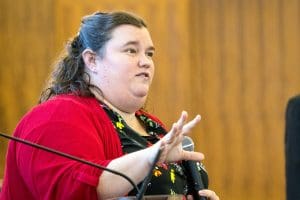
Elizabeth Rumley of the National Agricultural Law Center says of the research fellows, “They’ve all been wonderful in their own way.” (UADA photo)
FAYETTEVILLE, Ark. — The National Agricultural Law Center has been a trusted source for answers for nearly 40 years, and its more than 170 research fellows have played an important part in building its deep and publicly accessible knowledge base.
Since 2012, the NALC research fellows program has hosted 174 law students. Some stay for a semester. Others stay until they finish their law programs. Still others, like Brigit Rollins, just stay. Rollins is currently a staff attorney at NALC.
Rollins was attending Lewis and Clark Law School in Portland, Oregon, taking part in a legal clinic called the Western Resources Legal Center when she heard about the research fellow opportunity.
“I was in my second year and applied immediately,” Rollins said. “The summer before, I worked as a law clerk for the California Farm Bureau and found the work both interesting and fulfilling. At NALC, I knew for sure that I would get the chance to work on agricultural law topics.
“Working as a National Agricultural Law Center research fellow is a great option for law students, particularly those interested in how the law impacts agriculture,” she said.
“Not only are the hours flexible — something any busy law student will appreciate — but it also gives students the chance to start working on building the legal research and writing skills that they will need throughout their careers,” she said.
Zachary Gihorski, director of government affairs and sustainability for the National Council of Farmer Cooperatives, said that as a law student, he was introduced to NALC Director Harrison Pittman by Dudley Hoskins, who is now U.S. Department of Agriculture Undersecretary for Marketing and Regulatory Programs.
“Harrison and I ended up having what must have been a three-hour phone conversation. By the end of that conversation, he offered me the opportunity to serve as a research fellow during my second year of law,” he said. “I enjoyed and benefited from the experience enough that I continued with the program during my third year of law as well.”
“It was the best internship experience I had in law school,” Gihorski said. “The fellowship gave me the opportunity to work on practical, relevant agricultural law issues not just in theory, but in a way that helped build a stronger understanding of how legal research can serve people directly involved in agriculture.
To read the full article, click here.