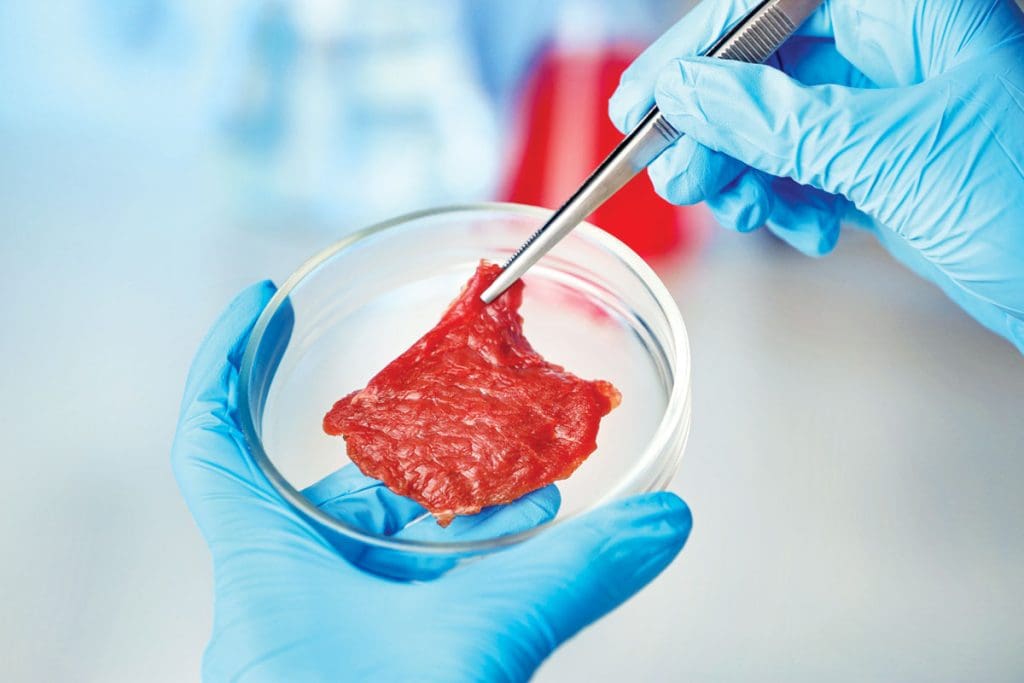
On March 23, 2026, the Eleventh Circuit published an opinion upholding a district court’s denial of a preliminary injunction in Upside Foods, Inc v. Simpson, et al. This ruling was one of the first appellate decisions to weigh in on how states can regulate the sale of alternative proteins. Specifically, the court affirmed a lower court decision upholding Florida’s law, which targets the production and sale of cell-cultured meat.
Background
In 2024, Florida became the first state in the nation to prohibit the manufacture, distribution, and sale of lab-grown meat. Introduced as SB 1084 and later codified at Fla. Stat. § 500.452(1)–(6), this law made it a second-degree misdemeanor for violators and authorized Florida officials to revoke permits of violating restaurants. This law went into effect on May 1, 2024. Not long after, this lawsuit was brought by Upside Foods.
Upside Foods (Upside) is a California based company that produces cell-cultured chicken. While Upside does not manufacture, or plan to manufacture, its cell-cultured chicken product in Florida, it has held a tasting event in Florida for interested chefs. It had additional tasting events planned in the state when this law took effect. Upside challenged the constitutionality of SB 1084 with three claims:
- that the law was expressly preempted by the Poultry Products Inspection Act (PPIA), which sets federal standards for poultry products and limits conflicting state requirements;
- even if it was not expressly preempted by the PPIA, Congress intended for the PPIA to occupy the field, leaving no room for state regulation; and
- that the law violates the Dormant Commerce Clause by discriminating against out-of-state businesses and placing an undue burden on interstate commerce.
At the District Court
In October of 2024, a judge in the Northern District of Florida denied Upside’s request for a preliminary injunction. A preliminary injunction is not a final judgement on the merits of a case, but a pretrial motion that can compel a party to begin or cease actions. Here, Upside was requesting that the State of Florida be prohibited from enforcing SB 1084 during the duration of the litigation. The court denied their request. However, in the denial, the district court urged Upside to file an amended complaint clarifying that it was “bringing preemption claims in equity.” Upside did so, and four days after filing the amended complaint, it appealed the preliminary injunction to the Eleventh Circuit. To learn more about preliminary injunctions, click here to read NALC article “Procedures: Injunctions.”
Though the injunction appeal was pending before the Eleventh Circuit, the district court continued with its considerations of the merits of the case and in May 2025, it granted in part and denied in part Florida’s motion to dismiss. Specifically, it dismissed Upside’s preemption claims but ruled that the Dormant Commerce Clause claim could continue. To read more about the specifics of this decision, click here to read NALC article “Alternative Proteins: 2025 Litigation Update.”
Before the Eleventh Circuit
In its review of Upside’s appeal, the Eleventh Circuit considered three issues: “mootness, the existence of a private cause of action to enjoin the enforcement of a preempted state law, and the likelihood of success on the merits of Upside’s preemption claims.”
Mootness
First, the Eleventh Circuit looked at the question of mootness. Article III of the U.S. Constitution requires that litigation cannot be moot. In other words, there must still be an unresolved issue where a court decision would have a real, practical effect. Here, the defendants argue that the question regarding the preliminary injunction has been resolved because Upside amended its complaint before appealing and the district court dismissed the preemption claims after Upside filed its notice of appeal.
The Eleventh Circuit disagreed with both of Florida’s mootness arguments. Specifically, the court found that the amended complaint did not change the “fundamental nature” of the case because it merely dropped certain defendants and reorganized the claims. Further, the court determined that the district court’s dismissal of the preemption claims does not render the preliminary injunction question moot because the court still could grant the relief Upside seeks. It emphasized that the district court’s partial dismissal is not a final judgment on the case, meaning that the underlying dispute remains active and capable of judicial resolution. Thus, the Eleventh Circuit found that Upside’s appeal of the denied preliminary injunction was not moot.
Cause of Action
Next, the court determined whether Upside had a cause of action to bring a preemption claim. The court recognizes that it is “ingrained in our jurisprudence” for a regulated entity (such as Upside) to have a cause of action in equity to halt enforcement of a preempted state law. Here, the court finds that Upside does have a cause of action because it is “advancing a constitutional defense to a putative prosecution under Florida law.” Thus, the Eleventh Circuit allowed that Upside to bring a preemption claim.
Likelihood of success on the merits
Last, the court looks at the merits of Upside’s preemption claim. Specifically, the court considered whether Florida’s law was likely to be preempted by specific provisions of the PPIA. Preemption is a legal theory that comes from the Supremacy Clause of the U.S. Constitution. It states that federal law is “the supreme law of the land,” and as a result, state laws that conflict with or interfere with federal law are invalid and cannot be enforced. To learn more about preemption, click here to read NALC article “Procedures: Federal Preemption.”
The federal law in question here is the PPIA. This federal law was enacted in 1957 and required USDA to establish federal standards for poultry products and inspect poultry products to prevent adulteration or misbranding. The PPIA includes two express preemption provisions – the Facilities Provision and the Ingredients Provision. To determine Upside’s likelihood of success on the merits of its preemption claim, the Eleventh Circuit discusses both provisions.
The PPIA’s Facilities Provision preempts state laws that create additional or different requirements “with respect to premises, facilities and operations of any official establishment.” 21 USC § 467e. Because the PPIA does not define premises, facilities, or operations, the Eleventh Circuit looks to the plain meaning of these terms. “Premises” and “facilities” are determined to mean the physical “site of poultry slaughtering or processing,” and “operations” is determined to mean “onsite operations.” Further, the court determines that the phrase “with respect to” narrows the scope of the provision to state laws with a “direct effect on premises, facilities, or operations.” Here, the court finds that SB 1084 is a “pure product ban” that does not reach into Upside’s premises, facilities, or onsite operations, nor tell the company how it should make its product. Thus, the Eleventh Circuit finds that the PPIA’s Facilities Provision is not likely to preempt SB 1084.
Next, the Eleventh Circuit turned to the PPIA’s Ingredients Provision. This clause preempts state laws that create additional or different “ingredient requirements . . . with respect to articles prepared at any official establishment.” 21 USC § 467e. Upside argues that SB 1084 is preempted by the Ingredients Provision because the law bans poultry products that contain “the ingredient of lab-grown cells.” Once again, the court looked to the plain meaning of these terms because the PPIA does not define “ingredient,” “requirement,” or “ingredient requirement.” The court defines ingredient as “something that enters into a compound or is a component part of any combination or mixture,” requirement as “a requisite or essential condition,” and ingredient requirement as “a rule establishing an essential component of a mixture or combination.” Here, the court disagrees with Upside’s claim that “chicken cells” are an ingredient because the PPIA does not describe ingredients at a cellular level and courts have traditionally upheld state laws that ban categories of meat. Thus, the Eleventh Circuit finds that SB 1084 is not likely to be preempted by the PPIA’s Ingredients Provision.
For a preliminary injunction to be issued, the moving party must typically satisfy four factors. However, if the first factor, substantial likelihood of success on the merits, is not met, then the court will not continue with its analysis. Here, because Upside did not demonstrate it would be likely to succeed on its preemption claim, the court did not address the other three factors. Because the elements were not met, the Eleventh Circuit affirmed the district court’s denial of a motion for preliminary injunction.
Next Steps
Though the Eleventh Circuit found that it was unlikely Upside would succeed on the merits of its preemption claim, this ruling was not a judgement on the merits. In the meantime, the district court has already dismissed the preemption claims. Because Upside did not file an appeal on that decision, the dismissal acts as a final judgment and those claims are no longer being considered.
However, Upside’s Dormant Commerce Clause claims remain before the district court and have not yet been resolved. The district court will consider whether Florida’s law impermissibly burdens or discriminates against interstate commerce under the Dormant Commerce Clause, a separate constitutional analysis from preemption.
As litigation continues, future rulings are likely to provide more guidance on the constitutionality of the Florida statute in regard to how states can regulate products that move through interstate markets. Those decisions could have broader implications beyond this case, potentially shaping how courts evaluate similar laws in other states.
To learn more about other state laws related to alternative proteins, click here to view NALC’s Alternative Protein Laws State Compilation.