
By Mary Hightower
University of Arkansas System Division of Agriculture
Fast Facts
- Learn more about the BE food disclosure standard
- AMS’ fact sheet on ‘what is a bioengineered food?’
FAYETTEVILLE, Ark. — Nearly a decade after Congress passed the National Bioengineered Food Disclosure Law, the Agricultural Marketing Service of the U.S. Department of Agriculture has been ordered to rework parts of the standard it created under that law.
The law required the Agricultural Marketing Service, or AMS, to create a national mandatory disclosure standard for “bioengineered foods.” AMS did so, releasing the National Bioengineered Food Disclosure Standard in 2018.
Defining ‘bioengineered’
The 2018 standard defines bioengineered food as containing “genetic material that has been modified through in vitro recombinant deoxyribonucleic acid (rDNA) techniques and for which the modification could not otherwise be obtained through conventional breeding or found in nature.” However, the standard clarifies that a food does not contain modified genetic material if that material isn’t detectable in the food.
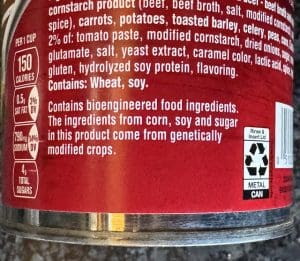
Under the standard, foods that meet one of three categories for “non-detectable” won’t be required to comply with the disclosure rules. Specifically, a food with modified genetic material is not considered detectable if it has undergone a high level of refinement or processing.
The law also required that labels include electronic links such as a scannable code, a phone number or other means to allow the consumer to learn more about the bioengineered ingredients.
Going to court
In 2020, Natural Grocers, Citizens for GMO Labeling, Label GMOs, Rural Vermont, Good Earth Natural Foods, Puget Consumers Co-op and the Center for Food Safety filed suit against USDA and AMS in the U.S. District Court for the Northern District of California. In its suit, the coalition said, “the agency fell far short of fulfilling the promise of meaningful labeling of [genetically engineered] foods.”
The plaintiffs challenged the standard for:
- Excluding highly refined foods from the definition of bioengineered foods
- The requirement to use the term “bioengineered” in disclosures
- Provisions related to use of scannable codes or text messaging for the required disclosures.
In September 2022, the district court rejected the claims about highly refined foods and use of the term “bioengineered,” but invalidated the standard’s electronic disclosure requirements, sending it back to AMS without vacating the entire standard.
The coalition appealed the district court decision to the Ninth U.S. Circuit Court of Appeals, which published its ruling in October 2025.
The appeals court found that “a showing of non-detectability of genetically modified material … is not legally equivalent to a determination that the food in question does not ‘contain’ such material.”
“In other words, the court disagreed with AMS’ interpretation that a food does not contain modified genetic material if the material is not detectable,” said Mary Eichenberger, research fellow for the National Agricultural Law Center. “This is important because it will require ‘highly refined foods,’ a category of foods that were previously exempted, to comply with the standard’s disclosure rules.”
However, the 9th Circuit rejected the plaintiffs’ claim that the term “genetically modified” should be used instead of “bioengineered.”
“Following the 9th Circuit’s decision, the case has now been sent back to the district court to consider next steps, including whether the regulations regarding ‘highly refined foods’ should be immediately voided or temporarily left in place,” Eichenberger said.
To read the full article, click here.