On January 7, 2025, U.S. Department of Agriculture’s (USDA) Secretary Rollins and Department of Health and Human Services’ (HHS) Secretary Kennedy unveiled the Dietary Guidelines for Americans, 2025-2030 (DGA). The Trump Administration is hailing the publication of this document as the “most significant reset of federal nutrition policy in our nation’s history.” This article will describe the history of the DGA, overview the changes in the newest iteration, and explain its impact.
Background of DGA
The DGA is a report, updated every five years, that contains “nutritional and dietary information and guidelines for the general public.” 7 U.S.C § 5341(a)(1). Additionally, the DGA is also used by Federal agencies in the execution of certain Federal nutrition programs. The DGA was first published in 1980 but became required by law under the 1990 National Nutrition Monitoring and Related Research Act. Per the law, the DGA must be “based on the preponderance of the scientific and medical knowledge which is current at the time the report is prepared.” 7 U.S.C. § 5341(a)(2).
Historically, the scientific and medical knowledge used to formulate the DGA is determined by the Dietary Guidelines Advisory Committee (DGAC). The DGAC is a group of nationally recognized experts in the fields of nutrition and health that are authorized by 42 U.S.C. § 217a and tasked with providing independent and science-based recommendations for the DGA. Per the 2025-2030 DGAC’s charter, USDA and HHS identified specific scientific questions for the DGAC to consider. The DGAC typically will have limited time, usually two years, to examine the questions given and develop a scientific report describing their review process and offering science-based advice to USDA and HHS. This scientific report is to be considered by USDA and HHS as they craft the DGA.
In 2022, USDA and HHS, under the Biden Administration, began the process of preparing the next DGA. First in 2022, the agencies requested comments on the proposed scientific questions and later, solicited nominations for the DGAC. In 2023, they announced the first meetings of the 2025 DGAC. This group would meet a total of seven times over the next two years, and published their findings in December of 2024 in a document titled “Scientific Report of the 2025 Dietary Guidelines Advisory Committee.”
Following the administration change in 2025, however, Secretaries Rollins and Kennedy determined that the DGAC’s report contained “deficiencies,” and should not be the basis of the DGA. The Secretaries citied their main concern with the DGAC’s report being its “health equity” framework and expressed displeasure for its focus on plant-based protein sources. Thus, instead of using the DGAC’s report, the Administration conducted an “independent evidence review process” with nutrition scientists and subject matter experts selected through a federal contracting process. The findings of this review process were published in both “The Scientific Foundation For The Dietary Guidelines For Americas” and its accompanying appendices.
The New DGA
The newly published DGA has been promoted using the tagline “Eat Real Food.” This slogan defines “eating real food” as “choosing foods that are whole or minimally processed and recognizable as food,” and further clarifies that those are foods with few ingredients. The biggest difference in the new DGA is its length – ten pages. To contrast, the previous 2020-2025 DGA was 164 pages. With short bullet points under eight listed categories, the new DGA gives advice for daily intake with “serving goals for a 2,000-calories dietary pattern.” Specifically, these categories include Eat the Right Amount for You; Prioritize Protein Foods at Every Meal; Consume Dairy; Eat Vegetables & Fruits Throughout the Day; Incorporate Healthy Fats; Focus on Whole Grains; Limit Highly Processed Foods, Added Sugars, & Refined Carbohydrates; and Limit Alcoholic Beverages. Sprinkled in throughout those listed categories is spotlighted advice on gut health, added sugars, and sodium. Following those general guidelines are specific guidelines for “Special Populations & Considerations,” such as Infancy & Early Childhood, Pregnant Women, and Vegetarians & Vegans.
The serving goals for the food categories are as follows:
- Protein – 1.2 -1.6 grams of protein per kilogram of body weight per day
- Dairy – 3 serving per day
- Vegetables – 3 servings per day
- Fruit – 2 servings per day
- Healthy fats – saturated fat consumption should not exceed 10% of total daily calories
- Grains – 2-4 servings per day
- Added sugars – no amount of added sugars or non-nutritive sweeteners is recommended and one meal should contain no more than 10 grams of added sugars
- Alcohol – consume less
In comparison with previous years, serving goals for protein increased, while vegetables, fruits, and grains decreased. Dairy serving goals and recommendations for saturated fats both stayed the same. However, the new DGA recommended prioritizing animal sources for “healthy fats,” such as beef tallow, and prioritizing whole grains over refined. The DGA included stronger language about added sugars, but weaker language about alcohol.
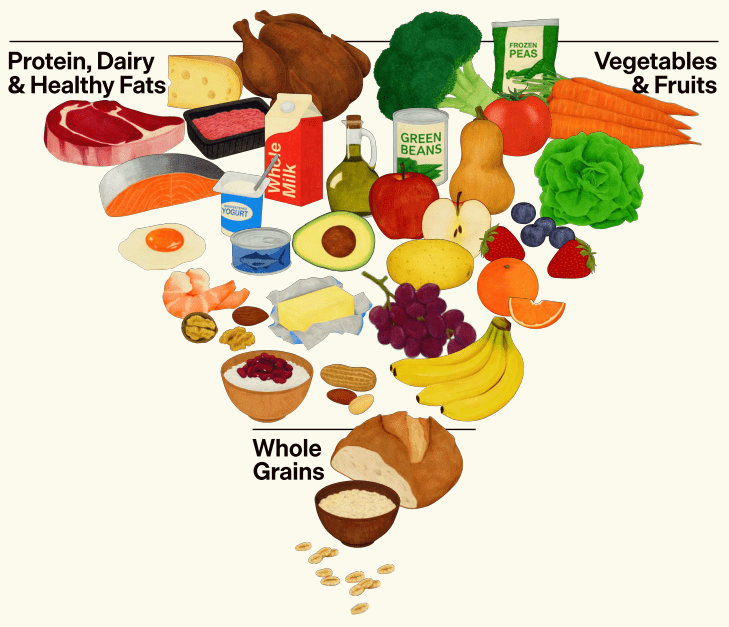
Along with the recommendations, the new DGA also includes what the administration is terming, “The New Pyramid.” This is an inverted pyramid with three highlighted categories: 1) Protein, Dairy, & Healthy Fats, 2) Vegetables & Fruits, and 3) Whole Grains. This is supposed to take the place of the “MyPlate” and older “Food Pyramid” nutrition models. On the new DGA website, the three pyramid categories are presented as follows:
- Protein, Dairy, & Healthy Fats – takes up the left top of the inverted pyramid with the tagline, “We are ending the war on protein.”
- Vegetables & Fruits – the right top of the inverted pyramid. Encourages the consumption of whole, colorful, nutrient-dense vegetables and fruits in their original form or with minimal processing.
- Whole Grains – the very bottom tip of the pyramid. Encourages the consumption of whole grains and discourages the consumption of refined carbohydrates.
Impacts of the new DGA
Statistically the DGA, which serves as a guidance for the general public, is not followed by Americans. A 2022 report from the Centers for Disease Control and Prevention shows that only 25.3% of adults had heard of MyPlate and only 8.3% had tried to follow its recommendations. However, the DGA does play an important role for federal agencies in their administration of federal food, nutrition, and health programs.
For instance, it is required by federal law that federally funded school meals are “consistent with the goals of” the latest DGA. 42 U.S.C. § 1758(f)(1)(A). This means that the USDA will typically update its school meal nutrition requirements to be “consistent with the ultimate objectives” of the DGA. In 2024, USDA published a final rule, “Child Nutrition Programs: Meal Patterns Consistent With the 2020-2025 Dietary Guidelines for Americans,” which, among other things, created added sugar limits in school lunch and breakfast programs to reflect DGA guidance that added sugar intake should be less than 10% of calories per day.
However, not every updated version of the DGA will lead to a major change in nutrition standards for school meal programs. For example, USDA determined that the 2015-2020 DGA was similar enough to the 2010-2015 DGA that school meal program nutritional standards did not need to be updated. It is not clear yet how the current administration will use the new DGA to update the school meals programs. Although in a recent op-ed, Secretary Rollins stated that “programs like school meals . . . will be updated to reflect the new dietary guidelines.” In this piece, the Secretary also mentioned USDA using the new DGA to update portions of all its 16 nutrition programs, including the Supplemental Nutrition Assistance Program and the Special Supplemental Nutrition Program for Women, Infants, and Children.
Response to new DGA
Reactions to the newly published DGA have varied among agriculture groups. For example, the National Cattlemen’s Beef Association and the Meat Institute celebrated its call to “prioritize protein at every meal.” While the reactions of some groups, like the American Soybean Association (ASA), were more mixed. Specifically, the ASA released a statement that both celebrated the DGA’s protein emphasis and expressed concern over the seed oil language in the DGA’s appendices.
For medical groups, the reactions have also varied. The president of the American Medical Association applauded the DGA’s advice on avoiding “highly processed foods, sugar-sweetened beverages, and excess sodium” and committed to helping “physicians translate this science into everyday care and helping patients improve their overall health.” In contrast, the American Heart Association had a more nuanced reaction. While the group celebrated the DGA’s recommendations about added sugars, refined grains, and highly processed foods, it expressed concern with the advice about “salt seasoning and red meat consumption” which it says could lead consumers to “exceed recommended limits for sodium and saturated fats, which are primary drivers of cardiovascular disease.”
Additionally, one medical group, the Physicians Committee for Responsible Medicine (PCRM), filed a petition with the Offices of Inspector General for both USDA and HHS alleging a conflict of interest in the creation of the DGA. Specifically, the petition alleges that the group who produced The Scientific Foundation for The Dietary Guidelines had “significant conflicts of interest” that “resulted in nutrition recommendations that favor” certain “economic interests.” The petition requests that the guidelines be withdrawn and redone using the “Scientific Report of the 2025 Dietary Guidelines Advisory Committee.”
Conclusion
The USDA and FDA are required by federal law to update the DGA every five years. This year, to produce the 2025-2030 DGA, the Trump Administration broke with tradition of using the recommendations from the Scientific Report of the 2025 Dietary Guidelines Advisory Committee and produced a 10-page document focused on the advice to “eat real food.” It is still unclear how the administration will use the DGA to update other federal programs, but the agencies will likely publish more information in the weeks to come. To stay up to date on the movements of USDA and FDA, click here to subscribe to NALC’s bi-weekly newsletter, “The Feed.”
For more information on the DGA, click here to read Congressional Research Service Report, “The Dietary Guidelines for Americans: Development, Implementation, and Considerations for Congress.”