Colby Johnson, Research Fellow
Brigit Rollins, Staff Attorney
On May 1, 2024, the Board of Lucas County Commissioners, City of Toledo, Ohio, and the Environmental Law & Policy Center filed a lawsuit against the Environmental Protection Agency (“EPA”) regarding the water quality of Lake Erie and one of its major tributaries, the Maumee River. The lawsuit represents the latest step in a line of litigation involving Lake Erie and challenges EPA’s administration of the Clean Water Act (“CWA”) in the Maumee River watershed in Ohio. Specifically, the lawsuit alleges that EPA improperly approved the state of Ohio’s proposal to regulate pollution in the watershed. The case is currently on-going and while it will likely be some time before the matter is resolved, should the plaintiffs prevail, the case may ultimately result in stricter regulation for agricultural operations throughout the region.
Overview of the Clean Water Act
The CWA was passed in 1972 in order “to restore and maintain the chemical, physical, and biological integrity of the Nation’s waters.” 33 U.S.C. § 1251(a). The statute relies on a number of complex and interrelated programs to achieve this goal.
A primary tool that the CWA uses to maintain the Nation’s waters is the establishment of total maximum daily loads (“TMDLs”) of pollutants that may be present in certain waterbodies. To set a TMDL, the CWA directs states to first establish water quality standards for the water bodies within their jurisdictions. 33 U.S.C. § 1313(d)(1)(A). These water quality standards are based on the designated uses of a water body – such as municipal water supply, recreation, industrial water supply, wildlife use, etc. – and the criteria necessary to protect the uses of that water. In other words, water quality standards identify how a water is used and what criteria are necessary to ensure that the water may continue being used in that manner.
After adopting water quality standards, the CWA then directs states to identify which waters within their borders have become impaired by pollution so that the water is not currently meeting water quality standards. States are required to submit their list of impaired waters to EPA for approval every two years. For those impaired waters, the CWA then requires states to establish TMDLs which identify the maximum amount of pollution a waterbody can receive without violating water quality standards. Because TMDLs are established for impaired waters that are already not in compliance with water quality standards, one way to think about a TMDL is as a calculation of how much pollutant loads must be reduced within a particular waterbody for it to meet those standards. Once a state has developed a TMDL for an impaired water, it must submit the TMDL to EPA for final approval.
Although the purpose of a TMDL is to reduce the number of impaired waters, a TMDL on its own does not establish new regulatory controls on sources of pollution. TMDLs are not self-implementing. Instead, TMDLs are implemented through other federal and state pollution control programs.
One such program is the CWA National Pollutant Discharge Elimination System (“NPDES”) permitting program. Under the CWA, no one may discharge a pollutant into a protected water from a “point source” without first receiving a NPDES permit.
The CWA defines a “point source” as any “discernible, confined and discrete conveyance” such as a pipe, ditch, or channel. 33 U.S.C. § 1362(15). The statute clarifies that all concentrated animal feeding operations are considered point sources but that return flows from irrigated agriculture are not. Sources of pollution that are not considered point sources are referred to as nonpoint sources. While a NPDES permit is required to make a lawful discharge of pollutants from a point source into a water protected by the CWA, nonpoint sources of pollution are largely unregulated at the federal level.
NPDES permits set limits on how much of a particular pollutant the permit holder may discharge into a particular waterbody from a specific point source. By setting limits on how much a permit holder may discharge, NPDES permits may be used to implement TMDLs. Pre-existing permits may be revised with stricter pollution limits in waters where new TMDLs are established while new permits issued for use in waters with current TMDLs will rely on those TMDLs to set permit limits. However, NPDES permits only address point sources of pollution. Nonpoint sources of pollution, including most agricultural pollution, are not regulated by the CWA. Instead, nonpoint sources of pollution are regulated primarily by the states. States may implement TMDLs through state-specific programs intended to reduce nonpoint source pollution.
Background: Maumee River Watershed TMDL
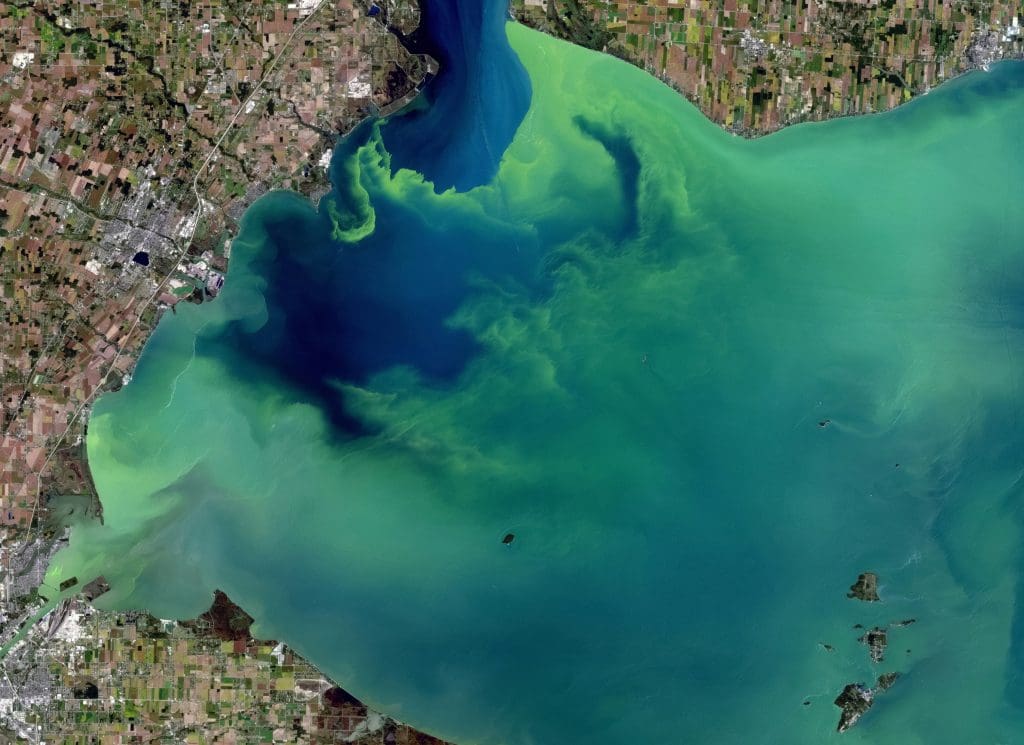
The city of Toledo, Ohio, sits in Lucas County, just off the mouth of the Maumee River. The watershed of the Maumee River is comprised mostly of agricultural land and predominantly flows into the western basin of Lake Erie. The region has a recent history of water quality concerns, most notably in 2014, when the city of Toledo experienced a drinking water crisis.
In 2017, the Advocates for a Clean Lake Erie as well as the Environmental Law & Policy Center (“ELPC”) sued the federal EPA for approving the Ohio EPA’s impaired waters list under the CWA. Ohio’s impaired waters list focused on the nutrient pollution of Ohio waters but did not include the open waters of western Lake Erie. More information on past litigation between these parties is available here.
Following the 2017 lawsuit, EPA withdrew its approval of Ohio’s impaired waters list, and in 2018, the Ohio EPA reassessed the nutrient pollution of western Lake Erie and designated it as an impaired water. The federal EPA approved Ohio’s designation which set development of a TMDL for Lake Erie as a low priority. Again, the ELPC filed a lawsuit against EPA for failing to properly oversee Ohio’s CWA compliance. This ELPC suit was joined together with a separate lawsuit of similar claims brought by the Board of Lucas County Commissioners.
The second lawsuit was filed in 2019. In 2020, Ohio drafted a TMDL plan for western Lake Erie giving the basin a high-priority designation and initiating public comments on the TMDL. Later that same year, EPA again approved Ohio’s plan to address nutrient pollution in western Lake Erie. After two and half years of litigation and attempts to resolve the issue outside of the court, EPA proposed a settlement in the form of a Consent Decree at the end of 2022. After the public comment period for the proposed settlement concluded, the ELPC raised eight specific objections to the settlement. A few months later, in 2023, the parties filed a joint motion to approve the Consent Decree and have it enforced by the court. This cooperative agreement put an end to nearly six years of consolidated litigation to restore and conserve the western basin of Lake Erie.
Much of the watershed surrounding the great lakes is agricultural land. With the exception of CAFOs, agricultural operations are typically classified as a nonpoint pollution source. Pollutants like nitrogen and phosphorus can leak into the water supply through runoff when manure or other fertilizers are over-applied to field crops. Likewise, feedlot operations can contribute to the pollution of nearby waters through runoff from manure or other waste products.
Changes to Ohio’s Maumee River TMDL could result in changes for farmers in the region. A stricter TMDL would likely impact CAFOs, smaller animal feeding operations, as well as those who farm field crops.
Current Litigation
The present lawsuit was brought by the Board of Lucas County Commissioners, the City of Toledo, and the ELPC against EPA. In the lawsuit, the parties contend that Ohio has not reduced harmful algal blooms, properly assessed the impairment, or established TMDLs, to remediate the waters of Lake Erie. The plaintiffs also claimed that EPA’s approval of the TMDL for the Maumee River violated the CWA in five specific ways.
According to the plaintiffs, EPA has failed to: (1) set limits on dissolved reactive phosphorus in the water; (2) set an adequate margin of safety in the TMDL calculation that accounts for a lack of knowledge about the relationship between pollutant limits and water quality; (3) assign wasteload allocations for CAFOs; (4) assign load allocation for nonpoint sources of pollution; and (5) supply reasonable assurances on its implementation plan.
To begin, the plaintiffs assert that dissolved reactive phosphorus (“DRP”) is the main driver of harmful algal blooms in the waters of western Lake Erie. They contend that DRP pollution in the watershed comes primarily from manure waste and fertilizer runoff from upstream agricultural land. Because the Maumee River TMDL sets limits for total phosphorus, the plaintiffs believe that particulate phosphorus reduction will not lead to the necessary limits on DRP in the water.
Second, the plaintiffs claim that the 3% margin of safety is not sufficient to comply with the CWA because it does not account for different phosphorus pollutants nor uncertainties raised by climate change. To support this assertion, the plaintiffs reference recent TMDLs in Minnesota and Michigan, as well as the Black River Watershed in Ohio, that use a larger margin to account for these concerns.
Third, the plaintiffs contend that at least seventy-three different CAFOs in the watershed have not been assigned wasteload allocations. Under the CWA, a CAFO is considered a point source that must receive a specific wasteload allocation in a state’s TMDL plan to remediate impaired waters. A wasteload allocation established by a given TMDL controls how much and what kind of discharge a NPDES permit allows. Here, the plaintiffs argue that Ohio illegally characterizes CAFOs as agricultural stormwater discharge and by doing so fails to treat large CAFOs in the watershed as the appropriate pollutant source contributing to the impairment of Lake Erie.
Fourth, the plaintiffs dispute EPA’s approval of Ohio’s method for determining the current and anticipated amount of nonpoint source pollution. State law requires Ohio to consider seven different factors in determining load allocations for these sources in a TMDL. The plaintiffs argue that Ohio has violated these statutes by treating the watershed landscape as a one size fits all rather than evaluating nonpoint source loads individually.
Finally, the plaintiffs assert that Ohio’s Maumee River watershed TMDL did not include a proper implementation plan or reasonable assurances of ever attaining water quality standards. The plaintiffs argue that Ohio law, as well as the Consent Decree the parties settled on in 2023, require an implementation plan for the TMDL. Without it, the plaintiffs contend that Ohio and EPA have given no further guarantees of practical steps to target and improve the specific pollution issues affecting western Lake Erie.
The plaintiffs have asked the court to declare EPA’s approval of the Ohio TMDL for the Maumee River watershed a violation of the CWA. Additionally, the plaintiffs request that the court overturn EPA’s approval and direct the agency and Ohio to develop a new TMDL that complies with the CWA.
EPA filed an answer to the complaint on July 29, 2024. There, EPA denies the allegation that Ohio has refused to establish a TMDL for Lake EPA also rejected the plaintiffs’ claim that Ohio’s proposed 40% reduction of total phosphorus loads could be accomplished without limiting DRP levels. Further, EPA denies the plaintiffs’ characterization of CAFO waste discharge and its alleged effect on surface waters. EPA also refutes the notion that there is significantly more nonpoint source pollution in the southern portion of the Maumee River watershed than in other sub-watershed regions. Finally, the defendants deny the truthfulness of allegations that there are massive economic and public health burdens on the plaintiff as a result of EPA’s management of harmful algal .
Conclusion
Following the original complaint and answer submitted in 2024, the United States District Court for the Northern District of Ohio has received numerous requests for third parties to intervene as parties in the case, requests for protective orders, to extend deadlines, and to amend or supplement other court documents. Currently, the court has allowed twelve parties to intervene for the sake of the defendants and three parties in the interests of the plaintiffs. The former includes the American Farm Bureau Federation, Ohio EPA, and several Ohio based agricultural trade associations, while the latter involves the Food & Water Watch, the Lake Erie Waterkeeper, and Waterkeeper Alliance, Inc. Other relevant motions to intervene have been denied, and some of those decisions have been appealed to the United States Court of Appeals for the Sixth Circuit.
This challenge to the validity of Ohio’s TMDL, and EPA’s approval of it, calls into question the legitimacy of the Consent Decree reached by the parties in 2023. The conclusion of that agreement came after years-long litigation and numerous actions from the parties. It is therefore unlikely that the current lawsuit will be resolved soon. Unless the parties can settle the case, the matter will remain unresolved until the court makes a final ruling. For agricultural producers in the region, the conclusion of the lawsuit may ultimately lead to tighter regulation.
To view the Board of Lucas County Commissioners’ initial complaint in the 2024 case, click here.
To view EPA’s reply, click here.
To view the text of the CWA, click here.
For more National Agricultural Law Center resources on the CWA, click here.