Dicamba FAQs & Resources
In 2016, the Environmental Protection Agency (EPA) approved the herbicide dicamba for direct use on dicamba-resistant soybean and cotton crops for the very first time. The move ultimately resulted in a series of lawsuits, reregistration decisions, and two court orders to overturn decisions authorizing over-the-top use of dicamba. This page is intended to provide resources and answers to some frequently asked questions concerning over-the-top use of dicamba. If you have a question that is not answered below, please contact us.
This information is provided for educational purposes only. If you have concerns that go beyond the scope of what has been discussed in any of the questions below, we encourage you to seek legal advice from a licensed attorney in your area. The questions are meant to provide general information only, and do not constitute any legal advice offered by the National Agricultural Law Center, nor act as a substitute for legal advice and counsel. This resource was last updated March 10, 2026.
Dicamba Basics
What is dicamba?
Dicamba is an herbicide that is designed to target broadleaf plants and is commonly applied to weeds that have become resistant to glyphosate. It works by imitating plant hormones that control plant growth. One distinctive characteristic of dicamba is its tendency to volatilize. This is a process where a pesticide evaporates and moves through the air as a vapor. Because of this, dicamba can drift much further from its application site than other pesticides and cause unintentional harm to plants that were not the target of the initial application. For more information on use of dicamba as an over-the-top herbicide, click here to view the University of Arkansas Division of Agriculture fact sheet, “Dicamba in Arkansas – Frequently Asked Questions.”
How is dicamba used?
Traditionally, dicamba was used as a pre-emergent herbicide that was applied as a burndown in late winter and early spring before crops were planted. This timing helped to reduce the impacts of dicamba volatilization. However, in 2015 the pesticide manufacturer Monsanto Company (now owned by Bayer) introduced a new line of dicamba resistant soybean and cotton seeds to the market. These new seeds were developed to survive the application of dicamba directly “over-the-top” of growing crops and were intended to be used with a new formulation of dicamba that was designed to have lower volatility than older formulations. EPA approved Monsanto’s low-volatility dicamba pesticide XtendiMax for over-the-top use with dicamba-tolerant soybean and cotton seeds during the 2016 and 2017 growing seasons. By the 2018 growing season, EPA had approved three dicamba pesticides for over-the-top use.
Which regulatory agencies govern the use of dicamba?
As with all other pesticides, dicamba and its usage in the United States is regulated on the federal level by the Environmental Protection Agency (EPA). While EPA plays the primary role in approving pesticides for use, state governments also have a role to play in pesticide regulation. If a state pesticide regulatory agency chooses to do so, under certain circumstances they are allowed to set regulatory limits stricter than those established by the federal government.
How does the Environmental Protection Agency (EPA) regulate the use of dicamba?
EPA regulates dicamba according to the framework established by the Federal Insecticide, Fungicide, and Rodenticide Act (FIFRA), the primary federal statute regulating pesticide use in the United States. No pesticide may be used or sold in the United States until EPA has registered a label for the pesticide under FIFRA. To register a pesticide label, FIFRA requires EPA to determine that use of the pesticide in its intended manner will not cause “unreasonable adverse effects on the environment.” 7 U.S.C. § 136a(c)(5)(C).
To learn more about how EPA registers pesticides for use, click here.
What is the importance of a pesticide label?
No one may distribute or sell a pesticide product in the United States unless it has been registered under FIFRA. 7 U.S.C. § 136a(a). A pesticide is not considered registered under FIFRA until EPA has approved a label for that pesticide product. A pesticide label contains important information, including the pesticide’s formulation, whether it is a general use pesticide that can be purchased and used by anyone or a restricted use pesticide which can only be used by a certified applicator, and use instructions for the pesticide. When it comes to use instructions, it is generally accepted that “the label is the law,” meaning that using a pesticide in a manner not described on its label is a FIFRA violation. Previous labels for over-the-top dicamba products have included use instructions describing how many applications can be made each growing season, the type of equipment that can be used to make those applications, restrictions on applying during certain weather conditions, and cut-off dates after which applications cannot be made.
What role do states play in pesticide regulation?
States have the ability to adopt state-specific pesticide laws and regulations provided they are at least as strict as those required under federal law. Specifically, FIFRA provides that states “may regulate the sale or use of any federally registered pesticide,” so long as they do not “impose or continue in effect any requirements for labeling or packaging in addition to or different from those required” by FIFRA. 7 U.S.C. §§ 136v(a), (b). In other words, FIFRA grants states the authority to regulate how pesticides are used within their borders so long as the state does not adopt labeling requirements for a pesticide that differs from federal labeling requirements. For example, Arkansas has used its pesticide regulatory authority to set cut-off dates for applications of over-the-top dicamba products through regulations adopted by its state Plant Board.
State legislatures may also pass laws limiting or banning the use of a particular pesticide or pesticide active ingredient. For example, several states in recent years have passed laws limiting the use of neonicotinoid pesticides, such as New York’s Birds and Bees Protection Act which bans the use of seeds coated with neonicotinoid pesticides and the use of neonicotinoids on ornamental plants and turf. To date, no state legislature has passed a law limiting the use of dicamba.
To find out which agency regulates pesticides in your state, click here to view a list of state pesticide regulatory agencies maintained by the National Pesticide Information Center.
What is the legal status of over-the-top dicamba use in the U.S. for agricultural purposes?
Currently, there are three over-the-top dicamba products approved for use on dicamba-resistant soybean and cotton crops in the United States. Those three products include Stryax, manufactured by Bayer; Engenia, manufactured by BASF; and Tavium, manufactured by Syngenta. The decision to register these products for use was issued on February 6, 2026 and will expire on February 8, 2028. Over-the-top dicamba will be available for use during the 2026 and 2027 growing season.
To learn more about the final registration decision and see the related documents, click here.
Is over-the-top dicamba currently approved for use in all states, or are there certain restrictions?
Currently, over-the-top dicamba products are approved for use in the following states: Alabama, Arizona, Arkansas, Colorado, Delaware, Florida, Georgia, Illinois, Indiana, Iowa, Kansas, Kentucky, Louisiana, Maryland, Michigan, Minnesota, Mississippi, Missouri, Nebraska, New Jersey, New Mexico, New York, North Carolina, North Dakota, Ohio, Oklahoma, Pennsylvania, South Carolina, South Dakota, Tennessee, Texas, Virginia, West Virginia, and Wisconsin.
Over-the-top use of dicamba may not be legally used in states not included in the above list.
In the states where dicamba can be applied, are there any restrictions to or requirements for application?
Yes. The three dicamba products that have been approved for over-the-top use in 2026 and 2027 include various application requirements on their labels. The instructions on the label must be followed in order to stay in compliance with FIFRA.
There are numerous application requirements on the approved dicamba labels. A full list of application requirements for over-the-top dicamba is available here. Highlights include:
- An annual maximum application limit of two applications of 0.5 lbs. of dicamba per acre.
- No applications may occur if the temperature is forecasted to be at or above 95°F on either the day of or the day after a planned application.
- No applications may occur during a temperature inversion or within 48 hours ahead of forecasted rainfall, if soil is saturated with water, or within one hour after sunrise or after two hours before sunset.
- A 240-ft downwind spray drift buffer must be maintained during applications. This distance may be decreased if additional label-approved mitigations such as hooded sprayers or additional downwind windbreaks are used.
- Agricultural producers must achieve 3 runoff/mitigation points from EPA’s certified conservation practices menu on each treated field prior to making an application. That requirement may increase to 6 points if the application is being made in a geographically specific pesticide use limitation area. The conservation practices menu can be found here. Information on pesticide use limitation areas can be found here. This application requirement comes from EPA’s Herbicide Strategy, more information on that policy is available here.
I’ve heard there’s more than one over-the-top dicamba label. What does that mean?
Before a pesticide may be sold or distributed in the United States, EPA must register the pesticide’s label under FIFRA. This means that each different pesticide product needs to have an individual label and registration, even if the products are intended for the same types of use with the same active ingredients. Some pesticide labels are registered “unconditionally,” meaning that EPA has received enough data to determine that long-term use of the pesticide will not cause “unreasonable adverse effects on the environment.” Unconditionally registered pesticide labels are subject to review by EPA every fifteen years but otherwise do not have an expiration date. Other pesticides are registered “conditionally.” Typically, EPA will register a pesticide conditionally when the agency finds that the pesticide meets the standard for registration but believes that more data is needed before EPA can grant unconditional registration. Conditionally registered labels often include expiration dates. When EPA first approved dicamba products for over-the-top use, the agency issued conditional registrations, indicating that EPA did not believe that use of over-the-top dicamba products would significantly increase the risk of unreasonable adverse effects on the environment during the time needed to generate additional data.
EPA first registered over-the-top use of dicamba on dicamba-tolerant soybean and cotton in 2016 on a two-year conditional registration. The initial registration was for Monsanto Company’s (now Bayer’s) XtendiMax but was amended the following year to include Corteva’s FeXapan and BASF’s Engenia. In 2018, EPA issued a second two-year conditional registration that authorized four dicamba pesticides – the three covered by the previous registration along with Syngenta’s Tavium – for over-the-top use. That registration was set to expire in late 2020. However, the Ninth Circuit Court of Appeals overturned EPA’s 2018 registration decision in June 2020 before the expiration date was reached.
On October 27, 2020, EPA announced it had conditionally registered XtendiMax, Engenia and Tavium for over-the-top use on dicamba-tolerant soybeans and cotton through the end of 2025. That time, FeXapan was not registered with EPA. That registration also faced legal challenges and was overturned by a federal court in Arizona on February 6, 2024.
Most recently, EPA announced on February 6, 2026, that it had conditionally registered Stryax, Engenia, and Tavium for over-the-top use on dicamba-tolerant soybean and cotton during the 2026 and 2027 growing seasons.
In total, since 2016, EPA has conditionally registered dicamba for over-the-top use four times.
Dicamba Litigation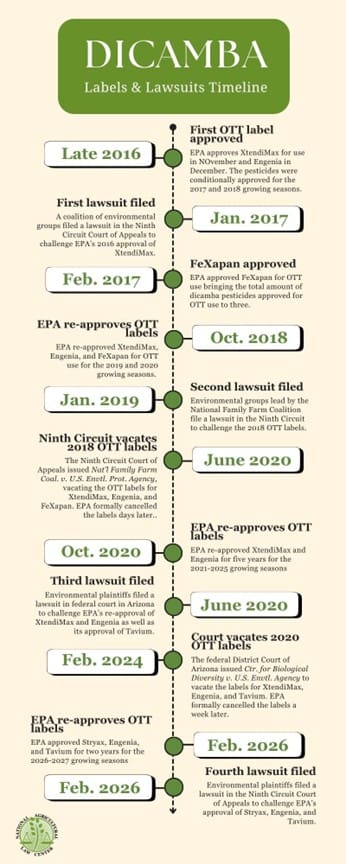
Have there been any recent changes in the legal framework surrounding over-the-top dicamba?
While there have been no recent changes to the structure of FIFRA or EPA’s process for approving pesticide labels, over-the-top dicamba usage has faced a series of legal challenges over the last several years. On two occasions, environmental groups successfully sued to overturn EPA’s approval of over-the-top dicamba. Although neither court decision changed the legal framework established by FIFRA, litigation surrounding over-the-top use of dicamba has impacted how such dicamba products are used.
How are legal challenges raised against pesticide labels?
FIFRA includes a judicial review provision that allows third parties to challenge EPA decisions made pursuant to FIFRA in federal court. The provision grants “any person who will be adversely affected” by an action taken by EPA under FIFRA the right to file a legal challenge either in federal district court or directly in a United State Court of Appeals.
What legal challenges have been raised against the approval or use of over-the-top dicamba?
To date, there have been four lawsuits filed since 2016 to challenge over-the-top use of dicamba. All four lawsuits have been filed by the same plaintiffs, and each claimed that efforts by EPA to register over-the-top dicamba violated aspects of both FIFRA and the Endangered Species Act (ESA). While the first case was dismissed because it challenged a registration decision that ultimately expired before the case could reach trial, both Nat’l Family Farm Coal. v. U.S. Envtl. Prot. Agency, No. 19-70115 (9th Cir. 2020) and Ctr. for Biological Diversity v. U.S. Envtl. Agency, No. 4:20-cv-00555 (D. Ariz. Feb. 6, 2024) resulted in a court order to rescind the registration for over-the-top dicamba.
The most recent lawsuit was filed on February 20, 2026 with the Ninth Circuit Court of Appeals and claims that EPA’s February 6 decision to register three over-the-top dicamba products for use violates FIFRA and the ESA. That case is currently being litigated.
What happened in Nat’l Family Farm Coal. v. U.S. Envtl. Prot. Agency?
This lawsuit ultimately resulted in the first court order to overturn EPA’s decision to register over-the-top dicamba. Following the EPA’s decision to register labels for over-the-top dicamba in 2018, environmental groups filed Nat’l Family Farm Coal. v. U.S. Envtl. Prot. Agency in the Ninth Circuit Court of Appeals, alleging that EPA’s registration decision violated both FIFRA and the ESA.
After considering the arguments presented, the Court ruled that the EPA registrations of XtendiMax, FeXapan and Engenia violated FIFRA. The court based its decision on three risks it believed EPA had understated when considering whether the pesticides would cause “unreasonable adverse effects on the environment” as well as three risks it found EPA failed to acknowledge at all. The three risks that the court believed EPA understated included: (1) the amount of acreage planted with dicamba-resistant seeds in 2018; (2) a conclusion that complaints of dicamba damage could have been either under-reported or over-reported; and (3) EPA’s decision not to estimate the amount of damage caused by over-the-top application. Then, the risks the court found EPA failed to acknowledge included: (1) substantial non-compliance with label requirements; (2) economic costs; and (3) social costs.
Ultimately, the Ninth Circuit’s decision resulted in EPA’s approval of XtendiMax, FeXapan, and Engenia being overturned during the middle of the 2020 growing season. To learn more about the Ninth Circuit’s ruling, click here.
What did the court say in Ctr. for Biological Diversity v. U.S. Envtl. Agency?
After EPA re-approved over-the-top use dicamba products in 2020, the registration decision was challenged once again when environmental groups filed Ctr. for Biological Diversity v. U.S. Envtl. Agency to challenge the registration decision for violating FIFRA and the ESA. The lawsuit was decided by the United States District Court for the District of Arizona on February 6, 2024. Although the plaintiffs argued that EPA had violated substantive provisions of both FIFRA and ESA, the court ultimately based its decision on the plaintiffs’ claims that EPA had violated the procedural requirements of FIFRA when registering the dicamba products for over-the-top use.
When registering a new pesticide label, FIFRA requires pesticide manufacturers to submit an application for the specific type of label that applies to the product. The type of label typically depends on the pesticide’s intended use and active ingredient and can determine what information the manufacturer must provide EPA, as well as the time EPA takes to review the registration application.
Two common types of labels are new use registration labels and “me-too” labels (more formally called substantially similar registrations). For EPA to issue a new use registration, the new use in question must be an “additional use pattern that would result in a significant increase in the level of exposure, or a change in the route of exposure, to the active ingredient of man or other organisms.” In other words, a new use registration is appropriate when the use significantly increases the amount of the pesticide’s active ingredient that is present in the environment. This label requires EPA to administer a much more extensive review of data for the pesticide and its use while a “me-too” registration applies a much lower standard. A “me-too” label is appropriate when the new pesticide product is identical in its formulation and intended use to one or more pesticide products currently registered for use. More information on the different types of pesticide labels is available here.
When EPA registered XtendiMax, Engenia and Tavium in 2020, it registered them under a “me-too” registration and label. The court in Ctr. for Biological Diversity v. U.S. Envtl. Agency held that EPA violated FIFRA procedures because the over-the-top use of dicamba products should have been registered under the new use registration. Additionally, FIFRA requires EPA to carry out “notice-and-comment” rulemaking procedures when taking certain actions. This is a process that requires federal agencies to provide an opportunity for the public to comment on the action before it is administered. Under FIFRA, EPA must administer notice-and-comment rulemaking procedures when granting a new use registration. Importantly, EPA did not administer notice-and-comment proceedings when registering dicamba for over-the-top use in 2020 because it did so under a “me-too” registration instead of a new use registration. As a result of the procedural violations, the court overturned the registration decision for XtendiMax, Engenia and Tavium.
To learn more about the court’s decision in Ctr. for Biological Diversity v. U.S. Envtl. Agency, click here.
Is there currently an ongoing lawsuit involving dicamba labels?
Yes. A coalition of environmental groups filed Nat’l Family Farm Coal. v. U.S. Envtl. Prot. Agency, No. 26-1021 (9th Cir. 2026) on February 20, 2026. The plaintiffs claim that EPA’s February 6, 2026 decision to register three dicamba products for over-the-top use violates both FIFRA and the ESA. The case is currently being litigated and it is not yet clear what the outcome will be.
How have these lawsuits affected the availability of over-the-top dicamba?
Both Nat’l Family Farm Coal. v. U.S. Envtl. Prot. Agency and Ctr. for Biological Diversity v. U.S. Envtl. Agency resulted in court orders overturning EPA’s decision to register dicamba-based pesticides for over-the-top use. Without a validly registered label, a pesticide may not be sold or distributed within the United States. Additionally, using a pesticide in a manner inconsistent with its approved label is prohibited under FIFRA. If a pesticide does not have a registered label, it is effectively illegal to use that pesticide. Both court decisions ultimately resulted in over-the-top dicamba no longer being available for use. In response, EPA issued a formal cancel order after each court decision to both officially cancel the registration and provide for some continued use.
What is a “cancel order” and why did EPA issue one after each over-the-top dicamba court decision?
FIFRA grants EPA the authority to either cancel or suspend pesticide registrations that do not comply with the requirements of FIFRA or otherwise cause “unreasonable adverse effects on the environment.” 7 U.S.C. § 136d(b). FIFRA and its regulations also permit EPA to decide whether, and under what conditions, the existing stocks of a pesticide that has had its registration cancelled may still be sold, distributed, or used. By choosing to issue a cancel order for over-the-top dicamba in 2020 and 2024, EPA was able to allow farmers who had already purchased over-the-top dicamba prior to the date the respective court orders were issued could still use that product as intended. The cancel orders also gave EPA the ability to instruct anyone who still had quantities of over-the-top dicamba that could not be legally used on how to safely dispose of the product.
To view the 2020 cancel order, click here. To view the 2024 cancel order, click here. To learn more about pesticide cancellation under FIFRA, click here.